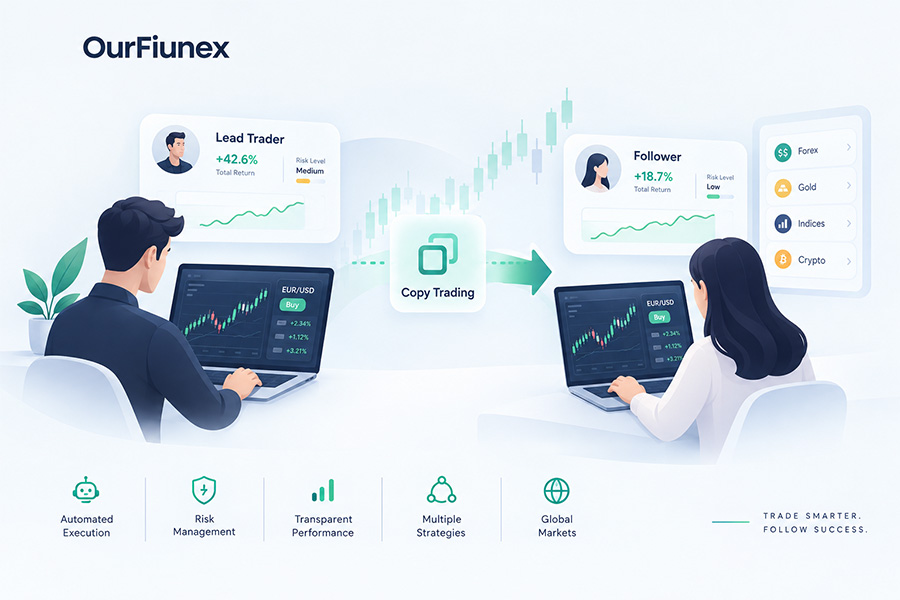
Copy trading is a trading method that allows users to automatically copy the trades of another trader or trading strategy into their own trading account.
Instead of analyzing every chart and manually placing every order, a copy trading system can replicate selected trading activity automatically. Depending on the platform, users may be able to choose a trader, strategy, or automated system based on factors such as historical performance, risk level, drawdown, trading style, and the markets being traded.
Copy trading has become increasingly popular among Forex and CFD traders because it combines automated execution with the ability to follow an established trading strategy.
But how does copy trading actually work? Is copy trading safe? How is it different from social trading, mirror trading, and AI copy trading?
This complete guide explains how copy trading works, its potential benefits and risks, and what traders should consider before using a copy trading platform.
What Is Copy Trading?
Copy trading is a form of automated trading where the trades of one account are replicated in another account.
The account being followed is commonly called the provider, strategy, or lead trader, while the account copying those trades is generally referred to as the follower.
For example, imagine a trader opens a EUR/USD buy position.
If you are connected to that trader through a copy trading platform, the system may automatically open a corresponding EUR/USD position in your account.
When the original position is closed, the copied position can also be closed according to the platform’s copying rules.
The exact execution method depends on the platform and its technology.
How Does Copy Trading Work?
Although different platforms use different architectures, the basic process is relatively simple.
Step 1: Choose a Trader or Strategy
The user reviews available traders or strategies on the platform.
Information may include:
- Historical returns
- Maximum drawdown
- Number of trades
- Trading history
- Risk metrics
- Trading instruments
- Average trade duration
- Account growth
- Strategy description
Step 2: Allocate Capital
The user decides how much capital to allocate to the selected strategy.
Some platforms allow users to determine the allocation as a fixed amount or percentage of their account.
Step 3: Enable Copy Trading
Once copying is activated, the platform monitors the selected trading activity.
Step 4: Trades Are Replicated
When the provider opens, modifies, or closes a trade, the copy trading system attempts to replicate the relevant action in the follower’s account.
Step 5: Monitor Performance
The user can monitor positions, account performance, drawdown, and other available metrics.
This creates an automated connection between the selected strategy and the user’s trading account.
What Markets Can Be Used With Copy Trading?
Copy trading is commonly associated with Forex, but the available markets depend on the platform and broker.
Potential markets include:
- Forex
- Gold
- Silver
- Indices
- Commodities
- Stocks
- CFDs
- Cryptocurrencies
For Forex traders, popular instruments can include EUR/USD, GBP/USD, USD/JPY, and XAU/USD.
However, availability, leverage, execution, and trading conditions can differ between brokers and jurisdictions.
Copy Trading vs Manual Trading
The biggest difference between copy trading and manual trading is who makes and executes the trading decisions.
With manual trading, the individual trader generally:
- Analyzes the market.
- Identifies a trading opportunity.
- Decides the position size.
- Places the order.
- Manages the position.
- Decides when to exit.
With copy trading, the user selects a strategy or trader and the platform handles the replication of trading activity.
| Manual Trading | Copy Trading |
|---|---|
| Trader makes individual decisions | Selected strategy provides trading decisions |
| Orders are usually placed manually | Orders can be replicated automatically |
| Requires active monitoring | Can reduce day-to-day monitoring |
| Trader develops their own strategy | User follows an existing strategy |
| More direct control over each decision | More dependent on the selected provider and platform |
Copy trading does not eliminate the need for decision-making. Selecting the strategy, determining capital allocation, understanding risk, and monitoring performance remain important.
What Is the Difference Between Copy Trading and Social Trading?
Social trading and copy trading are related but not identical.
Social trading focuses on interaction, information sharing, and observing other traders.
A social trading platform may allow users to:
- Follow traders
- Discuss strategies
- Share market analysis
- View trading activity
- Exchange ideas
Copy trading goes one step further by allowing trading activity to be replicated automatically.
In other words:
Social trading = follow and interact
Copy trading = follow and automatically replicate trades
Some platforms combine both approaches.
What Is Mirror Trading?
Mirror trading is another form of automated strategy replication.
The term generally refers to automatically mirroring the trades generated by a specific strategy or trading system.
The distinction between mirror trading and copy trading is not always consistent across platforms, and the terminology can overlap.
In practice, both concepts involve using technology to replicate trading decisions rather than manually entering every trade.
What Is AI Copy Trading?
AI copy trading combines automated trade replication with artificial intelligence or algorithmic market analysis.
Instead of simply copying the activity of a human trader, an AI-powered system may analyze market data and generate or manage trading decisions through an automated strategy.
Depending on its architecture, an AI trading system may evaluate factors such as:
- Price action
- Market trends
- Volatility
- Technical indicators
- Market structure
- Historical data
- Trading sessions
- Risk conditions
The resulting strategy can then potentially be made available through a copy trading system.
This creates a model where users can follow an automated strategy rather than manually analyze and execute every trade.
Copy Trading With MetaTrader 4 and MetaTrader 5
MetaTrader 4 and MetaTrader 5 are widely used platforms for Forex and CFD trading.
Copy trading can be implemented around MetaTrader accounts using different technologies, depending on the provider.
For example, a system may use:
- Expert Advisors
- Trade synchronization
- APIs
- Broker integrations
- Dedicated copy trading servers
- Automated account management systems
An Expert Advisor can also be used to execute or manage trading logic on MetaTrader.
This creates an important connection between Forex Expert Advisors, automated trading, and copy trading.
For more information about automated trading software, see our guide:
Forex Bot Expert Advisor: A Complete Guide to Automated Forex Trading
Benefits of Copy Trading
Copy trading offers several potential advantages.
1. Automated Trade Execution
One of the main benefits is automation.
Once a strategy is connected, trades can be replicated without manually entering every order.
2. Access to Different Strategies
Users can potentially explore different trading approaches without developing every strategy themselves.
For example, available strategies may focus on:
- Trend following
- Scalping
- Swing trading
- Breakouts
- Gold trading
- Forex trading
- Algorithmic trading
3. Reduced Manual Work
Copy trading can reduce the amount of time required for monitoring charts and entering orders.
This can be useful for users who cannot continuously watch the financial markets.
4. Portfolio Diversification
Some users may choose to allocate capital across multiple strategies with different approaches.
Diversification can potentially reduce dependence on a single trading methodology, although it does not eliminate market risk.
5. Performance Transparency
A well-designed copy trading platform can provide users with information about strategy performance and risk.
Useful metrics include:
- Return
- Drawdown
- Number of trades
- Win rate
- Profit factor
- Average trade
- Exposure
- Trading history
Transparency allows users to make more informed decisions when comparing strategies.
What Are the Risks of Copy Trading?
Copy trading is not risk-free.
The fact that a strategy has generated profits in the past does not guarantee that it will continue to do so.
Market Risk
Financial markets can move unpredictably.
A strategy can experience losing trades or extended periods of underperformance.
Strategy Risk
Different strategies behave differently under different market conditions.
A trend-following strategy, for example, may behave differently during a prolonged sideways market.
Drawdown Risk
Every trading strategy can experience drawdowns.
A strategy with high historical returns may also have experienced significant declines.
Users should evaluate returns together with drawdown and other risk metrics.
Execution Risk
The copied trade may not always have exactly the same execution price as the original trade.
Differences can result from:
- Market liquidity
- Spread
- Slippage
- Broker conditions
- Execution speed
- Account type
Leverage Risk
Leverage can increase both potential gains and potential losses.
A highly leveraged strategy may experience significant account fluctuations even when its historical performance appears attractive.
How to Choose a Copy Trading Strategy
Choosing a strategy should involve more than looking at the highest percentage return.
Consider several factors.
Historical Performance
Review performance over a meaningful period rather than focusing on a short-term result.
Maximum Drawdown
Determine how much the strategy historically declined from a previous peak.
Trading Frequency
Understand whether the strategy opens a few positions per month or many trades every day.
Average Trade Duration
Some strategies hold positions for minutes, while others may hold positions for days or weeks.
Markets Traded
Check whether the strategy trades Forex, gold, indices, cryptocurrencies, or other instruments.
Risk Management
Look for information about:
- Stop Loss
- Position sizing
- Maximum exposure
- Maximum daily loss
- Maximum drawdown
- Leverage
Trading History
A complete trading history can provide much more information than a single profitability figure.
Why Maximum Drawdown Matters in Copy Trading
Suppose Strategy A generated a 40% historical return with a 35% maximum drawdown.
Strategy B generated a 25% historical return with a 10% maximum drawdown.
Looking only at returns would provide an incomplete picture.
The two strategies have experienced very different levels of historical risk.
This is why copy trading platforms should provide multiple performance metrics instead of presenting only total profit.
Users can then evaluate the relationship between return, risk, and consistency.
Can Copy Trading Be Profitable?
Copy trading can potentially be profitable when the underlying strategy generates profitable trades.
However, profitability is not guaranteed.
Several factors influence the final result, including:
- Strategy performance
- Market conditions
- Position sizing
- Capital allocation
- Trading costs
- Spread
- Slippage
- Leverage
- Execution quality
- Risk management
A strategy that performs well historically can still experience future losses.
For this reason, copy trading should be treated as a method of accessing and automating trading strategies, not as a guaranteed source of income.
Is Copy Trading Safe?
The safety of copy trading depends on several factors.
Users should consider both financial risk and platform risk.
A reliable copy trading environment should provide clear information about:
- How trades are copied
- Where funds are held
- Risk controls
- Trading history
- Strategy performance
- Fees
- Account permissions
- Broker relationships
Users should also understand exactly what permissions are required to connect their trading account.
No copy trading system can remove the inherent risk of financial markets.
How Risk Management Works in Copy Trading
Risk management can be implemented at several levels.
Trade-Level Risk
Each individual position can have its own Stop Loss and position-size rules.
Account-Level Risk
The platform or strategy can apply limits to total account exposure.
Strategy-Level Risk
A strategy can have predefined limits for maximum positions, leverage, or drawdown.
User-Level Risk
The user can control how much capital is allocated to a strategy.
Combining these layers can create a more structured approach to automated trading.
Copy Trading and Diversification
Some traders use multiple strategies instead of relying on a single provider.
For example, a portfolio could potentially contain strategies with different characteristics:
- Forex trend following
- Gold trading
- Short-term scalping
- Swing trading
- Breakout strategies
- AI-based market analysis
The objective is not necessarily to maximize the number of strategies.
Instead, the key consideration is how the strategies behave relative to one another.
If several strategies take very similar positions, using multiple strategies may not provide as much diversification as expected.
AI vs Human Copy Trading
Traditional copy trading commonly follows the activity of a human trader.
AI copy trading can instead use algorithmic systems to analyze markets and execute predefined or dynamically generated strategies.
| Human Trader | AI Trading System |
|---|---|
| Decisions made by a person | Decisions generated by software |
| Can incorporate human judgment | Can process large amounts of data |
| Performance can depend on trader behavior | Performance depends on model and strategy design |
| May be affected by emotions | Automated execution can reduce manual emotional intervention |
| Trading approach may evolve manually | System behavior depends on its programming and model |
Neither approach automatically guarantees better results.
The most important factors remain strategy quality, risk management, execution, and transparency.
Common Copy Trading Mistakes
Choosing a Strategy Only Because of High Returns
A high historical return does not automatically mean that a strategy has an acceptable risk profile.
Ignoring Drawdown
Always examine historical drawdown alongside returns.
Allocating Too Much Capital
Even a strategy with strong historical performance can experience losing periods.
Using Excessive Leverage
High leverage can magnify losses.
Copying Too Many Similar Strategies
Several strategies may appear different but still have highly correlated exposure.
Not Understanding the Strategy
Before allocating capital, users should understand what the strategy trades and how it manages risk.
Copy Trading for Beginners
If you are new to copy trading, a structured approach can help.
Step 1: Learn the Basics
Understand Forex, leverage, spreads, margin, drawdown, and position sizing.
Step 2: Review Available Strategies
Compare historical performance, drawdown, trading frequency, and strategy characteristics.
Step 3: Start With Appropriate Risk
Avoid allocating capital that you cannot afford to lose.
Step 4: Monitor the Strategy
Even automated systems should be monitored.
Step 5: Review Performance Periodically
Evaluate both profitability and risk rather than focusing only on short-term gains.
The Future of Copy Trading
Copy trading is evolving from simple trade replication toward increasingly automated and data-driven systems.
Modern platforms can combine:
- Algorithmic trading
- Expert Advisors
- Artificial intelligence
- Automated risk management
- Portfolio analytics
- Real-time performance monitoring
- Multi-strategy portfolios
This evolution can make automated trading more accessible while also increasing the importance of transparency and risk management.
The next generation of copy trading platforms is likely to focus not only on copying trades, but also on helping users understand why a strategy trades, how much risk it takes, and how it behaves across different market conditions.
How OurFiunex Approaches Copy Trading
OurFiunex is designed around the idea of combining automated trading, AI-powered strategies, and copy trading into a streamlined trading environment.
Instead of requiring users to manually monitor every market movement, an automated strategy can analyze market conditions and execute its trading logic while users can monitor available performance and risk information.
The goal is to make automated strategies easier to understand and access while keeping risk information visible.
As with any financial trading system, users should evaluate strategies based on their own objectives, risk tolerance, and financial circumstances.
Frequently Asked Questions About Copy Trading
What is copy trading?
Copy trading is a trading method that allows users to automatically replicate the trades of another trader or trading strategy in their own trading account.
How does copy trading work?
A copy trading platform connects a follower account to a selected trader or strategy and automatically attempts to replicate relevant trading actions.
Is copy trading profitable?
Copy trading can potentially generate profits when the underlying strategy is profitable, but losses are also possible and future performance is not guaranteed.
Is copy trading good for beginners?
Copy trading can reduce the amount of manual trading required, but beginners still need to understand market risk, leverage, drawdown, and strategy selection.
What is AI copy trading?
AI copy trading combines automated trade replication with AI or algorithmic systems that analyze market data and generate or manage trading decisions.
Can I copy Forex traders?
Yes. Forex is one of the markets commonly supported by copy trading platforms, although available instruments and trading conditions depend on the platform and broker.
Can copy trading work with MetaTrader 5?
Yes. Copy trading systems can be integrated with MetaTrader 5 through different technologies, including Expert Advisors and other automated synchronization systems.
How much money do I need for copy trading?
There is no universal minimum. The required amount depends on the platform, broker, strategy, account type, and minimum position size.
What is the most important metric in copy trading?
There is no single metric that tells the entire story. Historical return, maximum drawdown, number of trades, exposure, trading frequency, and risk management should be evaluated together.
Final Thoughts
Copy trading provides a way to automate the replication of trading strategies without requiring users to manually execute every trade.
Its combination with Forex trading, MetaTrader, Expert Advisors, algorithmic systems, and artificial intelligence creates a growing ecosystem of automated trading solutions.
However, automation does not remove financial risk.
Before following a strategy, examine its historical performance, maximum drawdown, trading behavior, risk controls, execution conditions, and capital requirements.
The objective should be to understand the strategy and its risks rather than simply choosing the strategy with the highest historical return.
Explore automated strategies and AI-powered copy trading with OurFiunex.
Risk Disclosure: Trading Forex, CFDs, cryptocurrencies, and other leveraged financial instruments involves substantial risk and may result in the loss of invested capital. Past performance does not guarantee future results. Always consider your financial situation and risk tolerance before trading.