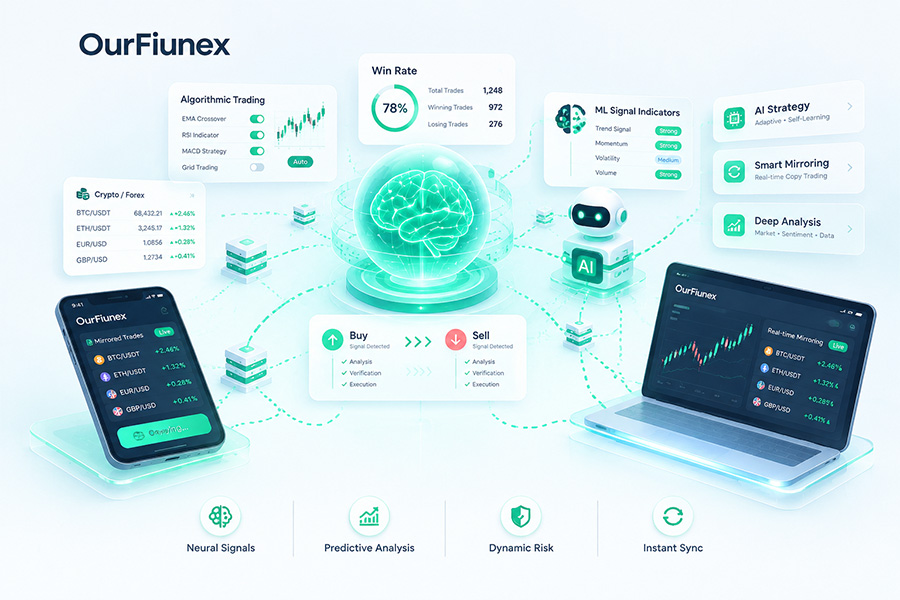
Artificial intelligence is changing the way traders analyze financial markets, manage trading strategies, and automate transactions.
One of the most interesting developments is the emergence of AI copy trading platforms, which combine automated trading with copy trading technology. Instead of manually analyzing charts or placing every trade, users can follow an AI-powered trading strategy and automatically replicate its trading activity.
But what exactly is an AI copy trading platform? How does it work? What makes AI copy trading different from traditional copy trading? And what should you look for when choosing an AI trading platform?
This guide explains how AI copy trading works, how automated strategies can be connected to trading accounts, and the key factors to consider before using an AI-powered trading platform.
What Is an AI Copy Trading Platform?
An AI copy trading platform is a trading environment that combines artificial intelligence or algorithmic trading systems with automated trade copying.
Traditional copy trading allows users to follow another trader and automatically replicate their trades.
AI copy trading introduces an additional layer of automation.
Instead of relying exclusively on the decisions of a human trader, an AI-powered system can analyze market data, identify trading opportunities, apply predefined rules, and potentially execute trades automatically.
The basic concept can be represented as:
Market Data → AI Analysis → Trading Strategy → Trade Execution → Copy Trading
Depending on the platform, the AI system may analyze price movements, technical indicators, volatility, market structure, historical data, and other available information.
When a trading signal or strategy decision is generated, the platform can execute the trade and make it available for copying.
How Does AI Copy Trading Work?
The exact technology differs between platforms, but the overall process typically follows several stages.
1. Market Data Collection
An AI trading system requires data to analyze market conditions.
Depending on its design, this may include:
- Price data
- Candlestick data
- Technical indicators
- Volatility measurements
- Trading volume
- Historical market data
- Market structure
- Trading sessions
- Economic or market information
The quality and relevance of the data can affect the behavior of an automated strategy.
2. AI or Algorithmic Analysis
The system processes available information according to its trading model.
An AI-powered system may be designed to identify:
- Trends
- Momentum
- Breakouts
- Reversal conditions
- Volatility changes
- Market patterns
- Potential entry conditions
- Potential exit conditions
Not every platform uses machine learning in the same way. Some systems described as AI trading platforms may combine traditional algorithmic strategies with AI-based analysis.
3. Strategy Decision
The trading system evaluates its conditions and determines whether a trading opportunity meets the strategy’s requirements.
For example, an automated Forex strategy may require several conditions to be satisfied before opening a position.
The system can also apply risk-management rules before executing the trade.
4. Trade Execution
Once the strategy generates a valid trading decision, an order can be sent to the connected trading environment.
Depending on the platform, execution may involve:
- MetaTrader 4
- MetaTrader 5
- Broker APIs
- Expert Advisors
- Trading servers
- Other supported trading integrations
5. Copying the Trade
If the strategy is available through copy trading, connected follower accounts can replicate the relevant trading action.
This means users do not necessarily have to manually enter every trade.
6. Risk and Performance Monitoring
A complete AI copy trading platform should provide tools for monitoring strategy behavior.
Useful information can include:
- Profit and loss
- Maximum drawdown
- Number of trades
- Current positions
- Exposure
- Trading frequency
- Historical performance
- Risk level
This information helps users understand how a strategy behaves rather than relying only on a single profitability number.
AI Copy Trading vs Traditional Copy Trading
The main difference is the source of the trading decisions.
With traditional copy trading, users generally follow a human trader.
With AI copy trading, the strategy may be generated or managed by an automated algorithm or AI-powered system.
| Traditional Copy Trading | AI Copy Trading |
|---|---|
| Often follows a human trader | Can follow an automated AI strategy |
| Decisions may depend on human judgment | Decisions are generated by software |
| Human execution or automated replication | Automated analysis and execution may be combined |
| Performance depends on the trader’s methodology | Performance depends on the AI model and strategy |
| Can involve manual strategy management | Can operate continuously according to programmed rules |
Neither model eliminates financial risk.
The quality of the underlying strategy, risk management, execution, and market conditions remain important.
Why Are Traders Interested in AI Copy Trading?
AI copy trading combines several technologies that traditionally required separate systems.
A user may gain access to:
- Automated market analysis
- Algorithmic trading
- Automated trade execution
- Copy trading
- Performance monitoring
- Risk-management tools
This can reduce the amount of manual work involved in following an automated strategy.
For users who do not want to spend hours watching charts, automation can provide a more systematic way to participate in trading strategies.
Key Features of an AI Copy Trading Platform
Not every platform offers the same functionality.
When evaluating an AI copy trading platform, consider the following features.
Automated Trade Execution
The platform should be capable of executing trades according to the selected strategy without requiring manual order entry for every position.
Real-Time Strategy Monitoring
Users should be able to see relevant information about the strategy and its current trading activity.
Performance Analytics
A useful platform should provide more than a simple profit percentage.
Important metrics can include:
- Total return
- Drawdown
- Win rate
- Profit factor
- Number of trades
- Average trade
- Exposure
- Trading duration
Risk Management
Risk controls are particularly important when trading is automated.
Possible controls include:
- Position-size limits
- Stop Loss
- Maximum open positions
- Maximum daily loss
- Maximum exposure
- Drawdown protection
Multiple Trading Strategies
Some platforms allow users to choose between different automated strategies.
Strategies may have different characteristics, such as:
- Trend following
- Scalping
- Swing trading
- Breakout trading
- Gold trading
- Forex trading
- Multi-market strategies
Having multiple strategies can give users more flexibility when constructing their trading approach.
AI Copy Trading for Forex
Forex is one of the most common markets associated with automated trading.
An AI Forex strategy can potentially analyze currency pairs such as:
- EUR/USD
- GBP/USD
- USD/JPY
- USD/CHF
- AUD/USD
- USD/CAD
- NZD/USD
Some strategies may also trade XAU/USD (Gold) or other instruments depending on the broker and platform.
However, a strategy designed for one currency pair should not automatically be assumed to perform the same way on another.
Each market has different characteristics, including volatility, liquidity, spread, and price behavior.
AI Copy Trading and MetaTrader 5
MetaTrader 5 is widely used for automated Forex and CFD trading.
AI and algorithmic strategies can interact with MT5 through different architectures.
For example, an automated trading environment may use:
- Expert Advisors
- MQL5
- Trading APIs
- External AI services
- Automated trade synchronization
- Dedicated trading servers
This makes MetaTrader 5 an important component of many automated trading ecosystems.
For traders interested in Expert Advisors, it is also useful to understand the relationship between an EA and an AI trading strategy.
An EA can execute a predefined algorithm directly inside MetaTrader, while an external AI system may perform analysis elsewhere and communicate trading decisions to the trading environment.
AI Trading Bot vs AI Copy Trading
An AI trading bot and an AI copy trading platform are related, but they are not exactly the same.
An AI trading bot is primarily responsible for analyzing markets and executing a trading strategy.
An AI copy trading platform adds the ability for other users to follow and replicate the strategy.
The relationship can be illustrated as:
AI Trading Bot → Generates/Executes Strategy → Copy Trading System → Follower Accounts
This architecture allows an automated strategy to become accessible to multiple users through a single trading environment.
Benefits of Using an AI Copy Trading Platform
Less Manual Trading
Users do not necessarily need to monitor charts continuously or manually enter every trade.
Automated Execution
Trading decisions can be translated into orders automatically according to the strategy’s rules.
Access to Algorithmic Strategies
Users can potentially follow strategies that would otherwise require significant technical knowledge to implement independently.
Consistent Execution
Automation can help a strategy follow its predefined rules consistently.
Strategy Selection
Platforms may allow users to compare different strategies based on performance and risk information.
Continuous Market Monitoring
Automated systems can monitor markets during the hours they are configured to operate.
What Are the Risks of AI Copy Trading?
AI does not make financial markets predictable.
An AI copy trading platform can still experience losses.
Market Risk
Unexpected market movements can cause strategies to lose money.
Model Risk
An AI or algorithmic model may behave differently under market conditions that were not represented adequately in its development or testing.
Overfitting
A strategy can sometimes be excessively optimized using historical data.
Such a strategy may perform extremely well during testing but behave differently when exposed to new market conditions.
Execution Risk
Real trading results can differ from theoretical or backtested results because of:
- Spread
- Slippage
- Liquidity
- Execution speed
- Broker conditions
Leverage Risk
Leveraged trading can amplify both profits and losses.
Technology Risk
Automated systems depend on software, servers, network connectivity, and integrations.
Technical interruptions can affect execution.
How to Evaluate an AI Trading Strategy
One of the biggest mistakes a user can make is choosing an AI strategy based only on its highest historical return.
A better evaluation includes several metrics.
Historical Return
Shows how the strategy performed during a specific historical period.
Maximum Drawdown
Shows the largest historical decline from a previous peak.
Number of Trades
A larger trading history can provide more information about the strategy’s behavior.
Profit Factor
Provides an indication of the relationship between gross profits and gross losses during the measured period.
Win Rate
Shows the percentage of trades that were profitable.
However, win rate should always be evaluated alongside average winning and losing trades.
Risk Level
Understand how aggressively the strategy uses capital and leverage.
Strategy Duration
A strategy with a long and transparent trading history may provide more context than a strategy with only a few weeks of results.
Why Transparency Matters in AI Copy Trading
AI trading can sometimes appear complicated because users may not understand exactly how the system makes decisions.
A good platform should therefore provide understandable information about the strategy.
Users should ideally be able to see:
- What markets are traded
- How frequently the strategy trades
- Historical performance
- Maximum drawdown
- Current exposure
- Risk characteristics
- Trading history
- Important strategy limitations
Transparency does not eliminate risk, but it allows users to make more informed decisions.
Can AI Copy Trading Guarantee Profits?
No.
There is no legitimate AI trading system that can guarantee a specific future return.
Financial markets contain uncertainty, and even sophisticated algorithms can experience losing periods.
Historical performance should therefore be treated as historical information rather than a promise of future results.
A responsible AI copy trading platform should emphasize both performance and risk.
AI Copy Trading and Risk Management
Risk management is one of the most important components of automated trading.
An AI strategy can generate a trading signal, but the way that trade is sized and managed can have a major effect on the account.
A platform may use controls such as:
Maximum Risk Per Trade
Limits the amount of account capital exposed to an individual position.
Maximum Daily Loss
Stops or restricts trading after reaching a predefined daily loss level.
Maximum Drawdown
Provides a broader account-level risk threshold.
Maximum Open Positions
Prevents the strategy from accumulating excessive simultaneous exposure.
Position Sizing
Controls the size of trades based on available capital or predefined risk parameters.
These controls can be particularly important when copying automated strategies.
How to Start With AI Copy Trading
For someone new to AI copy trading, the process can be relatively straightforward.
Step 1: Understand the Basics
Learn the fundamentals of Forex, leverage, margin, spreads, drawdown, and position sizing.
Step 2: Select an AI Strategy
Review the available strategies and examine their historical performance and risk characteristics.
Step 3: Review the Trading History
Look beyond total profit.
Examine drawdown, trade frequency, losing periods, and exposure.
Step 4: Determine Your Capital Allocation
Decide how much capital is appropriate for the strategy based on your own financial circumstances and risk tolerance.
Step 5: Monitor the Strategy
Automation does not mean that the account should be ignored.
Regularly review strategy performance and risk.
What Makes an AI Copy Trading Platform Different?
The quality of an AI copy trading platform is not determined by the word “AI” alone.
A complete platform should combine several components:
Technology
Reliable infrastructure for market analysis and trade execution.
Strategy
A clearly defined trading methodology.
Risk Management
Controls designed to limit excessive exposure.
Transparency
Accessible information about performance and risk.
Execution
Reliable communication between the strategy and trading account.
User Experience
A clear interface that makes it easy to understand strategies and monitor accounts.
These components work together to create a complete automated trading environment.
OurFiunex: AI Copy Trading for Automated Strategies
OurFiunex brings AI-powered trading strategies and copy trading together in one platform.
The concept is designed around allowing users to discover automated strategies, review available performance and risk information, and follow selected strategies without manually executing every trade.
By combining AI trading, automated execution, and copy trading, OurFiunex aims to create a simpler way to interact with algorithmic trading strategies.
The platform can be particularly relevant for users interested in:
- AI Forex trading
- Automated trading
- Copy trading
- MetaTrader trading
- Algorithmic strategies
- AI trading systems
- Risk-managed automated strategies
The most important principle remains transparency.
Users should understand that automated trading involves risk and that historical performance does not guarantee future results.
AI Copy Trading vs Traditional Expert Advisors
Traditional Expert Advisors are generally installed directly on a MetaTrader account and execute the strategy programmed into the EA.
AI copy trading can provide a different user experience.
Instead of requiring every user to configure and operate their own automated strategy, a platform can make a strategy available through a centralized copy trading infrastructure.
This can simplify access to automated strategies while providing centralized strategy monitoring and analytics.
Both approaches have their own technical and operational characteristics.
The Future of AI Copy Trading
AI copy trading is part of a broader shift toward automated and data-driven financial technology.
Future trading platforms may combine:
- Artificial intelligence
- Machine learning
- Algorithmic trading
- Automated risk management
- Portfolio optimization
- Real-time analytics
- Multi-market strategies
- Automated copy trading
As these technologies evolve, transparency will become increasingly important.
Users need to know not only how much a strategy has earned historically, but also how it manages risk, how it behaves during difficult market conditions, and what assumptions its trading model relies upon.
Frequently Asked Questions
What is an AI copy trading platform?
An AI copy trading platform combines AI or algorithmic trading strategies with automated trade copying, allowing users to follow and replicate the activity of selected automated strategies.
How does AI copy trading work?
An AI system analyzes market data according to its strategy, generates trading decisions, executes trades, and can make those trades available for automatic replication by connected follower accounts.
Is AI copy trading profitable?
AI copy trading can potentially generate profits, but it can also produce losses. No trading system can guarantee future profitability.
Is AI copy trading safe?
AI copy trading involves financial and technological risks. Users should evaluate strategy performance, drawdown, leverage, execution, platform security, and risk-management controls before allocating capital.
Can I use AI copy trading with MetaTrader 5?
AI copy trading systems can be integrated with MetaTrader 5 through technologies such as Expert Advisors, APIs, and automated trade synchronization, depending on the platform.
What is the difference between AI trading and copy trading?
AI trading refers to using artificial intelligence or algorithms to analyze and trade markets. Copy trading refers to automatically replicating another trader’s or strategy’s trades. An AI copy trading platform combines both concepts.
Can AI trading bots guarantee profits?
No. AI trading bots cannot guarantee future profits because financial markets are uncertain and strategies can experience losses.
What should I look for in an AI copy trading platform?
Consider strategy transparency, historical performance, maximum drawdown, risk controls, trading history, execution quality, supported markets, fees, and the technology used to connect trading accounts.
Final Thoughts
An AI Copy Trading Platform combines automated market analysis, algorithmic trading, and trade replication into a single environment.
For traders, this can provide a way to access automated strategies without manually analyzing every chart or entering every trade.
However, automation does not eliminate financial risk.
Before choosing an AI trading strategy, evaluate its historical performance, maximum drawdown, trading behavior, risk controls, execution conditions, and capital requirements.
The most useful AI copy trading platforms are not simply focused on generating trading signals. They also provide users with the information and tools needed to understand the relationship between performance and risk.
Discover AI-powered automated trading and copy trading with OurFiunex.
Risk Disclosure: Trading Forex, CFDs, cryptocurrencies, and other leveraged financial instruments involves substantial risk and may result in the loss of invested capital. Past performance does not guarantee future results. Always consider your financial situation and risk tolerance before trading.