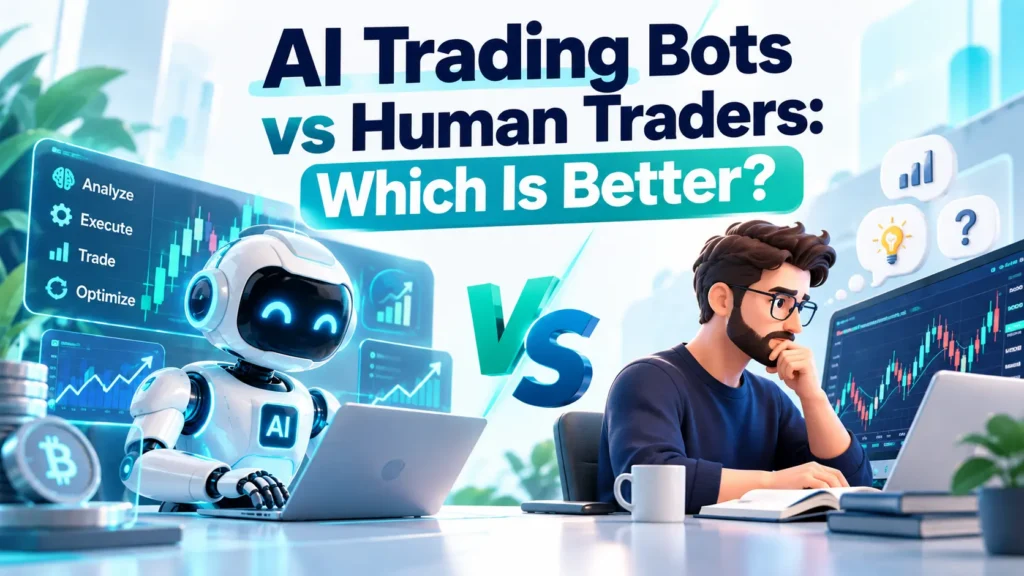
AI trading bots vs human traders is a comparison between two very different approaches to financial markets. AI trading bots can process market data and execute predefined decisions quickly and consistently, while human traders can interpret context, apply judgment, and adapt when market conditions change.
There is no universal answer to which approach is better. The right choice depends on the strategy, time horizon, asset class, market conditions, risk controls, and the quality of the trading system.
When comparing AI trading bots vs human traders, it is also important to distinguish artificial intelligence from ordinary automated trading. Many trading systems use simple rules, statistical models, or traditional algorithms rather than advanced AI or machine learning.
The more useful question is not simply whether AI is better than humans. It is which type of decision-making is more appropriate for a particular trading problem.
What Is an AI Trading Bot?
An AI trading bot is an automated software system that analyzes market information and may generate or execute trading decisions using programmed rules, statistical models, machine-learning models, or other computational techniques.
A simple automated system might buy when a short-term moving average crosses above a long-term moving average.
A more sophisticated machine-learning system can analyze variables such as price, volume, volatility, order-book data, and other market information to estimate the probability of a particular outcome.
Not every trading bot is an AI trading bot. Algorithmic trading generally uses computerized instructions to automate trading or execution, while AI trading can use machine learning or other AI techniques to generate predictions, signals, or decisions.
How Does an AI Trading Bot Work?
An AI trading system normally follows several stages.
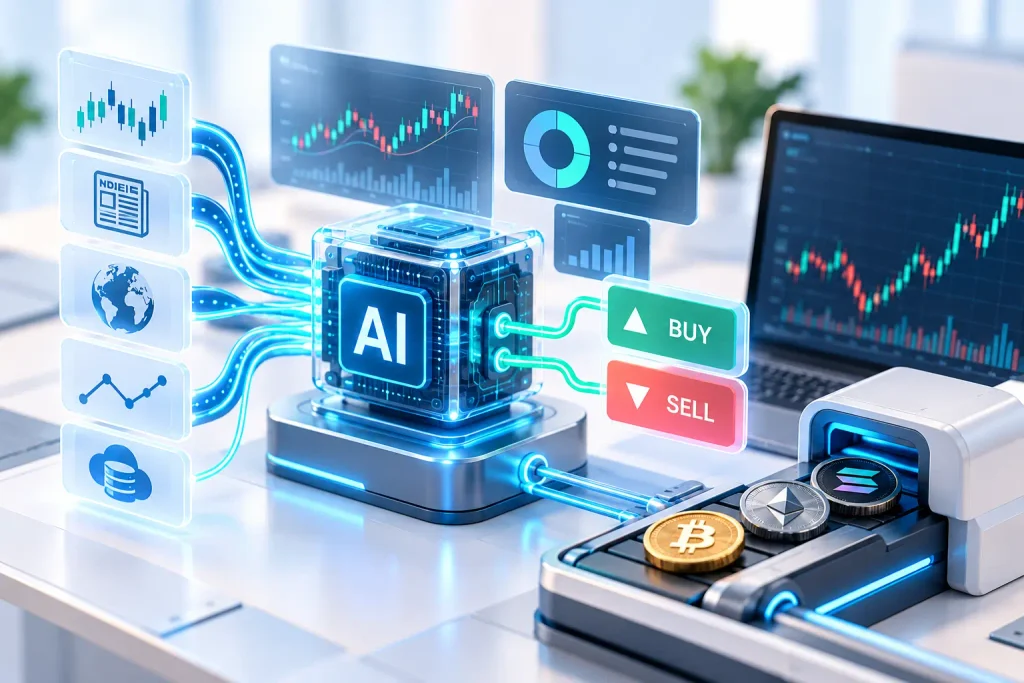
1. Data Input
The system can receive price and volume data, technical indicators, order-book information, fundamental data, macroeconomic information, news, and historical market data.
The quality of these inputs is critical. Even a sophisticated model can generate poor decisions when its data is inaccurate, incomplete, delayed, or poorly selected.
2. Data Processing
Raw market data is cleaned, transformed, and converted into useful features.
A model might analyze volatility, momentum, volume, returns, or moving-average relationships rather than using raw prices alone.
3. Signal Generation
The system can generate signals such as buy, sell, hold, reduce exposure, or enter a position when predefined conditions are met.
4. Risk Management
A trading signal is not the same as an order. A system may also determine position size, maximum exposure, stop-loss levels, leverage limits, and maximum daily losses.
5. Execution
The bot can communicate with a broker or exchange through an API.
Execution introduces practical variables such as spreads, fees, liquidity, latency, slippage, partial fills, and rejected orders.
6. Monitoring
Automated systems still require monitoring, testing, and risk controls. Automation changes how risk is managed; it does not eliminate risk.
FINRA notes that AI is already being explored in areas such as smart order routing, price optimization, best execution, and trade allocation, while warning that unusual market conditions can cause models to behave unpredictably. FINRA
AI Trading Bots vs Human Traders: Core Differences
AI trading bots can offer major advantages in speed, consistency, scalability, and large-scale data processing.
Human traders can offer advantages in contextual reasoning, qualitative analysis, and adapting to situations that were not represented in historical data.
| Factor | AI Trading Bots | Human Traders |
|---|---|---|
| Execution speed | Very fast | Slower |
| Consistency | High when properly programmed | Can vary |
| Emotional bias | No human emotions | Vulnerable to emotional decisions |
| Data processing | Can process large datasets | Limited by attention |
| Contextual judgment | Depends on model and inputs | Strong in ambiguous situations |
| Unexpected events | May behave poorly outside assumptions | Can reinterpret conditions |
| Scalability | High | Limited by time |
| Rule discipline | Consistent | Can override rules |
| Maintenance | Requires technical monitoring | Requires continuous attention |
| Adaptability | Depends on system design | Can adapt through judgment |
Neither approach guarantees better financial performance.
AI Trading Bots vs Human Traders: Speed and Execution
One of the clearest advantages of automation is speed.
A program can analyze market conditions and submit an order much faster than a person performing the same process manually.
This can matter particularly for short-term strategies where execution speed, liquidity, and latency are important.
FINRA has identified several trading applications of AI and machine learning, including smart order routing and price optimization. FINRA
AI Trading Bots vs Human Traders: Strategy and Flexibility
Automated systems work particularly well when the strategy can be clearly defined.
For example, a bot can consistently follow rules based on moving averages, volatility, price ranges, or predefined risk limits.
A human trader can approach the same market differently.
A discretionary trader may decide not to trade because market conditions appear unusual, even when a technical setup technically satisfies the normal entry criteria.
This difference becomes important when comparing systematic and discretionary trading.
Where AI Trading Bots Have an Advantage
Speed
Bots can respond to predefined market conditions almost instantly.
Consistency
A programmed system can follow its rules without fear, excitement, or hesitation.
Large-Scale Monitoring
A bot can monitor many assets and timeframes simultaneously.
Reduced Emotional Bias
Automation can reduce some behavioral problems associated with fear, greed, overconfidence, or revenge trading.
Scalability
The same strategy can potentially be applied across multiple markets without requiring the trader to manually monitor every position.
However, scalability also creates a warning: scaling a poor strategy can scale its losses.
Where Human Traders Have an Advantage
Contextual Judgment
Markets are influenced by events that may not fit historical patterns.
Unexpected geopolitical developments, regulatory decisions, monetary-policy changes, exchange outages, or structural shifts can change the environment very quickly.
FINRA warns that unusual volatility, geopolitical developments, natural disasters, and other conditions outside model training can reduce the reliability of AI trading predictions. FINRA
Understanding Ambiguous Information
Suppose a company reports stronger-than-expected earnings.
An automated model may process the numerical data, while a human analyst may also consider whether the results were already priced into the stock, whether management changed its guidance, and how investors are interpreting the announcement.
Strategic Flexibility
A human trader can simply decide not to trade.
That flexibility can be valuable when market conditions are highly unusual.
Qualitative Information
Some information is difficult to convert into reliable numerical variables.
Management commentary, emerging regulations, changing market narratives, and new risks may require interpretation rather than straightforward pattern recognition.
AI Trading Bots vs Human Traders: The Role of Backtesting
Backtesting is one of the most important parts of evaluating an automated strategy.
A backtest asks what a strategy would have done using historical market data.
That can be useful, but it does not prove how the same strategy will perform in the future.
A strategy may fail after deployment because market conditions changed, transaction costs were underestimated, slippage was ignored, or the model was overfit to historical data.
Important measures include:
- Maximum drawdown
- Volatility
- Risk-adjusted returns
- Win rate
- Average win versus average loss
- Turnover
- Transaction costs
- Slippage
- Performance across different market regimes
A high historical return is not enough to establish that a trading model is robust.
What Is Overfitting?
Overfitting occurs when a model becomes too closely adapted to historical data.
Imagine testing thousands of strategies against historical prices. Some will inevitably produce impressive results simply because they happen to fit the particular dataset.
The problem is that those patterns may not continue in live markets.
This is one reason out-of-sample testing is important when evaluating AI trading systems.
AI Trading Bots vs Human Traders: Emotional Bias
Human traders bring psychology into the decision-making process.
Common behavioral biases include:
Overconfidence
A trader may believe their market interpretation is more accurate than it actually is.
Fear
After losses, a trader may exit too early or avoid a valid opportunity.
Greed
After a series of winning trades, a trader may increase risk excessively.
Recency Bias
Recent price movements may receive too much importance.
Confirmation Bias
A trader may focus on information supporting an existing position while ignoring contradictory evidence.
Revenge Trading
A trader may increase risk after a loss in an attempt to recover money quickly.
Automation can reduce some of these emotional reactions, although it cannot correct a flawed trading strategy.
Can AI Trading Bots Predict the Market?
AI trading bots cannot reliably predict the future with certainty.
AI models can identify patterns, generate forecasts, and estimate probabilities. Markets, however, contain noise, changing relationships, competing participants, and unexpected events.
The CFTC specifically warns that AI does not turn trading bots into guaranteed money-making systems and cautions investors about claims of extremely high or guaranteed returns. CFTC
The appropriate way to view AI is as a trading technology that can automate analysis or execution, not as a machine that removes uncertainty.
What Happens When Market Conditions Change?
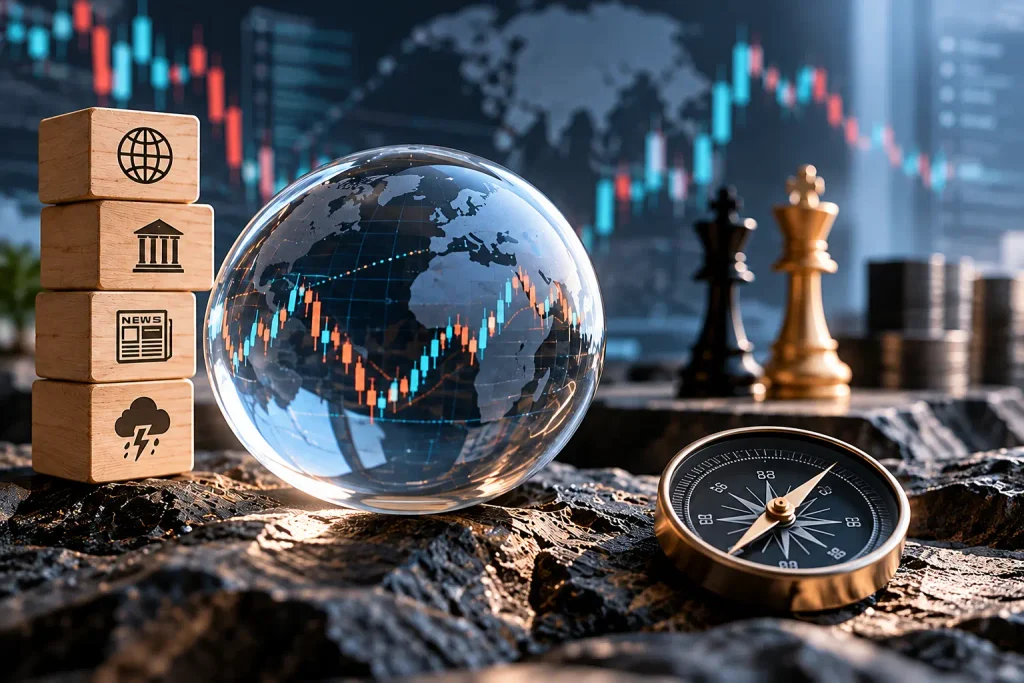
This is one of the most important limitations when comparing AI trading bots vs human traders.
Consider an AI system trained mainly on normal market conditions.
A sudden geopolitical event then causes extreme volatility and liquidity changes.
The model may continue following its programmed logic even though the market environment is completely different.
A human trader can also make mistakes, but may recognize that the assumptions behind the strategy are no longer valid.
This is why human oversight can remain important even in highly automated trading environments.
AI Trading Bot Risks
Automated systems introduce several categories of risk.
Model Risk
The model may generate incorrect signals.
Data Risk
Poor or incomplete data can produce poor decisions.
Execution Risk
A correct signal can still result in an unfavorable trade because of slippage, liquidity, spreads, or latency.
Infrastructure Risk
Software bugs, API failures, server problems, and exchange outages can interrupt trading.
Cybersecurity Risk
Trading accounts and API credentials can become security targets.
Autonomy Risk
More advanced AI systems may perform actions beyond what the user intended if permissions and safeguards are poorly designed.
Correlated-Model Risk
If large numbers of market participants use similar models or strategies, their actions can become correlated.
AI Trading Bots vs Human Traders: Which Approach Fits Different Markets?
There is no single approach that fits every market.
Fast and highly systematic markets
Automation can be particularly useful when speed, repetition, and continuous monitoring are important.
Markets requiring contextual interpretation
Human judgment can be more valuable when qualitative information and unusual events strongly affect prices.
Highly volatile markets
Both approaches require strong risk management. Automation can enforce predefined limits, while human oversight can help identify regime changes.
Cryptocurrency Markets
Crypto markets operate continuously and can experience significant volatility.
Automated systems can monitor them around the clock, but that does not make them inherently safer.
For readers exploring crypto trading automation, you can also link to your internal article on [AI crypto trading bots and automated trading tools]. The article on your site compares several automated trading solutions and discusses their limitations. AI crypto trading bots and automated trading tools
Should Beginners Use AI Trading Bots?
Beginners should not treat an AI trading bot as a substitute for understanding trading.
Before using a bot, understand:
- What strategy it follows.
- Which assets it trades.
- How position size is determined.
- How losses are controlled.
- How the backtest was created.
- Whether fees and slippage were included.
- What happens during an API or exchange outage.
- How the system can be stopped.
- What account permissions it requires.
- How live performance compares with historical testing.
The SEC, NASAA, and FINRA have warned about investment fraud involving AI claims, including unregistered platforms making unrealistic claims about automated trading systems. Investor
How to Evaluate an AI Trading Bot
Before using an automated system with real capital, evaluate both the strategy and the technology.
Strategy Evaluation
Ask:
- What is the underlying strategy?
- Is it rule-based, statistical, machine-learning-based, or agentic?
- How long is the backtest?
- Is there out-of-sample validation?
- Are fees included?
- Is slippage included?
- What is the historical maximum drawdown?
Technology Evaluation
Check:
- API permissions
- Security controls
- Emergency stop functions
- Exchange compatibility
- Logging
- Credential protection
- Server reliability
Provider Evaluation
Look for:
- A verifiable company
- Transparent methodology
- Clear risk disclosures
- Realistic claims
- Transparent fees
- Independent information
- No pressure to deposit money immediately
Do not treat screenshots or testimonials as proof of long-term performance.
Red Flags in AI Trading Bot Marketing
Be skeptical of claims such as:
- Guaranteed profits
- Never loses
- 100% win rate
- Risk-free AI trading
- Guaranteed monthly income
- Secret institutional algorithm
- The bot predicts the market
- No experience required
The CFTC has specifically warned about AI trading schemes that promise extraordinarily high or guaranteed returns. CFTC
Investor.gov likewise advises investors to be cautious of AI-related investment schemes that promise high returns with little or no risk. Investor
Can Human Traders and AI Work Together?
Yes.
A hybrid approach can divide responsibilities according to the strengths of each side.
The AI system can:
- Monitor markets
- Process large datasets
- Identify patterns
- Generate candidate signals
- Execute predefined orders
The human trader can:
- Define objectives
- Set risk limits
- Review assumptions
- Monitor unusual market conditions
- Suspend strategies
- Audit system behavior
This approach can be useful because it combines automation with human oversight.
For additional internal linking, you can connect the phrase [AI-powered crypto trading] to your existing Hyperbot article, which discusses AI-based automated trading and execution. AI-powered crypto trading
AI Trading Bots vs Human Traders: What Is the Future?
AI trading is likely to become increasingly automated, but more automation does not necessarily mean that human traders will disappear.
AI can assist with market research, data analysis, signal generation, portfolio monitoring, and execution.
At the same time, model risk, cybersecurity, auditability, supervision, and human oversight become increasingly important as automated systems gain more control.
The future may therefore involve more collaboration between human decision-makers and automated systems rather than a simple replacement of humans by AI.
AI Trading Bots vs Human Traders: The Real Decision Framework
Instead of asking only which approach is better, consider five questions.
1. Does the strategy require speed?
If speed and repetitive execution are essential, automation can provide a structural advantage.
2. Does the strategy require contextual judgment?
If ambiguous information and unusual events matter, human judgment can remain important.
3. Can the strategy be clearly defined?
Strategies that can be expressed precisely are easier to automate, test, and monitor.
4. How robust is the strategy?
A strong backtest is not enough. Evaluate the strategy across different market conditions and realistic execution assumptions.
5. Who is responsible when the system is wrong?
Automation does not transfer financial responsibility to the software.
Conclusion
AI trading bots vs human traders is not a simple competition with one universal winner.
AI systems can offer speed, consistency, scalability, continuous monitoring, and reduced emotional interference. They can also suffer from model risk, overfitting, poor data, execution problems, cybersecurity issues, and unexpected behavior when market conditions change.
Human traders can provide contextual reasoning, qualitative analysis, strategic flexibility, and the ability to respond to unusual situations. They are also vulnerable to emotions, overconfidence, inconsistent discipline, and behavioral biases.
The most useful approach is to evaluate the trading problem itself.
Some strategies are better suited to automation. Others depend heavily on contextual human judgment. In many cases, combining AI tools with human oversight can provide a practical middle ground.
AI can automate trading decisions, but it cannot eliminate market uncertainty.
«AI crypto trading bots and automated trading tools» → AI crypto trading bots and automated trading tools «AI-powered crypto trading» →. AI-powered crypto trading
FINRA guidance on AI in trading → FINRA AI Applications in the Securities Industry
CFTC warning about AI trading bots → CFTC AI Trading Bots Warning
SEC Investor Alert on AI and investment fraud → SEC Investor Alert: AI and Investment Fraud