
AI traders analyze the forex market by processing large amounts of market, economic, and behavioral data, identifying patterns, estimating probabilities, and applying predefined risk and execution rules. Depending on the system, the analysis can include price history, technical indicators, volatility, liquidity, economic releases, news, sentiment, and relationships between currency pairs.
Artificial intelligence does not give a trading system a reliable ability to predict the future. Instead, it provides a way to process information and generate forecasts or trading signals from data. Research from the Bank for International Settlements illustrates how AI can be used to monitor financial markets by using machine-learning models to analyze large sets of market indicators.
This distinction is important for anyone researching AI forex trading. An AI system may identify a pattern or estimate that a particular market condition has a higher probability of occurring, but the result remains a model-based estimate rather than a guaranteed prediction.
So, how do AI traders actually analyze the forex market? The process usually involves several interconnected stages, from collecting market data to interpreting economic conditions, generating signals, managing risk, and monitoring performance.
What Are AI Traders?
AI traders are trading systems that use artificial intelligence, machine learning, statistical models, or related computational techniques to analyze financial data and support or automate trading decisions.
Some systems are fully automated and can generate and execute orders without manual intervention. Others are decision-support tools that provide signals, forecasts, rankings, or market analysis while leaving the final trade decision to a human.
This means that the term “AI trader” can describe very different systems. A simple rules-based trading bot is automated but does not necessarily use machine learning. A machine-learning model that estimates the probability of a currency move is more directly AI or ML-based. A platform can also combine conventional technical indicators, statistical models, and machine learning into one trading architecture.
The distinction matters because the label AI-powered does not by itself tell you how sophisticated, reliable, or profitable a system is.
How Do AI Traders Analyze the Forex Market?
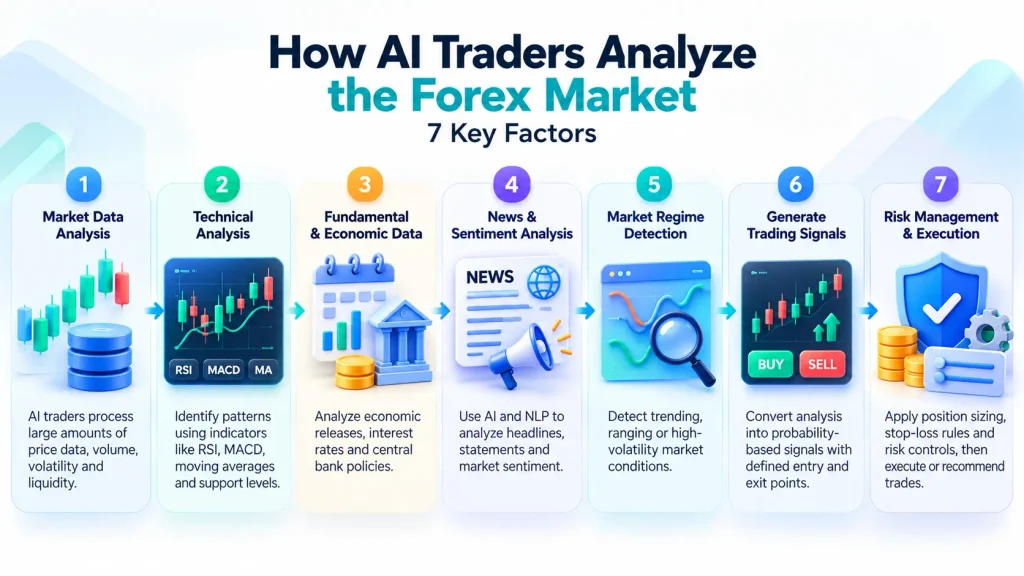
AI forex analysis generally follows a pipeline rather than a single calculation. The system collects inputs, processes them, identifies relationships or patterns, generates a signal or forecast, applies risk controls, and may then execute or recommend a trade.
The exact architecture depends on the system, but seven areas are particularly important.
1. AI Traders Analyze Large Amounts of Market Data
The first job of an AI trading system is to process data.
Forex markets generate continuous streams of information. Depending on the strategy, an AI system may examine:
- Historical price data
- Open, high, low, and close prices
- Trading volume where available
- Bid-ask spreads
- Volatility measurements
- Currency correlations
- Market liquidity indicators
- Economic calendar events
- Interest-rate information
- News and sentiment data
Machine learning becomes useful when the volume, frequency, or complexity of these inputs becomes difficult to analyze manually.
For example, a human trader might examine EUR/USD on several timeframes and compare a handful of technical indicators. A more complex AI system could simultaneously process multiple currency pairs, dozens of indicators, historical patterns, volatility measures, and macroeconomic variables.
However, more data does not automatically mean better analysis. Poor-quality, biased, outdated, or improperly structured data can lead to poor model outputs. This is one reason AI risk-management frameworks emphasize the importance of identifying and managing risks associated with AI systems throughout their lifecycle.
2. AI Traders Use Technical Analysis to Detect Patterns
Technical analysis focuses primarily on price and market behavior rather than the underlying economic value of a currency.
AI systems can process many of the same variables used by human technical analysts, including:
- Moving averages
- Relative Strength Index (RSI)
- Moving Average Convergence Divergence (MACD)
- Bollinger Bands
- Average True Range (ATR)
- Support and resistance levels
- Momentum
- Price patterns
- Volatility
The difference is that a machine-learning system can potentially evaluate relationships between multiple variables simultaneously.
For example, instead of treating an RSI reading as an isolated signal, an AI model could examine whether the same RSI condition has historically behaved differently during high-volatility periods, different market sessions, or different interest-rate environments.
The objective is not necessarily to find a universal rule. Instead, the model may attempt to estimate whether a particular combination of conditions has historically been associated with a particular outcome.
Pattern Recognition
Pattern recognition is one of the most frequently discussed applications of AI in trading.
A model can search historical data for recurring combinations of price movement, volatility, momentum, and other variables.
For example, it might identify that a specific price structure tends to be followed by short-term momentum under certain liquidity conditions.
That does not mean the pattern will repeat every time. Markets evolve, and patterns that were historically useful can weaken or disappear.
3. AI Traders Incorporate Fundamental and Economic Data
Forex markets are heavily connected to macroeconomic conditions because currencies represent economies and are influenced by interest rates, inflation, employment, economic growth, trade, and monetary policy.
Consequently, an AI forex system may incorporate fundamental variables alongside price data.
Relevant information can include:
- Central-bank interest-rate decisions
- Inflation releases
- Employment reports
- Gross domestic product data
- Purchasing Managers’ Index data
- Retail sales
- Industrial production
- Trade balances
- Consumer confidence
- Central-bank communications
Consider a system analyzing USD/JPY. It might combine recent price behavior with changes in interest-rate expectations, Japanese economic data, U.S. economic releases, and broader market volatility.
The model is not simply asking, “Did USD/JPY rise before?” It can attempt to evaluate how price behavior interacts with the economic environment.
4. AI Traders Can Analyze News and Market Sentiment
Traditional market models primarily rely on numerical data. More advanced AI systems can also process unstructured information such as news articles, headlines, central-bank statements, or other text-based sources.
This is where technologies such as natural language processing can become relevant.
A natural-language model can classify or extract information from text, such as:
- Positive or negative economic sentiment
- Changes in central-bank language
- Unexpected geopolitical developments
- Changes in economic expectations
- Emerging risks
In a market-moving environment, an AI system may therefore combine numerical market signals with textual information.
For example, suppose a central bank unexpectedly changes its language regarding future interest rates. An AI system equipped to analyze financial news or statements could incorporate that information into its assessment more quickly than a workflow based entirely on scheduled economic indicators.
However, interpreting language is not risk-free. Financial statements can be ambiguous, context-dependent, or difficult to quantify. A model can also incorrectly interpret uncertainty, changing terminology, conflicting reports, or incomplete information.
5. AI Traders Detect Market Regimes
One of the more advanced applications of AI in forex is market-regime detection.
A market regime is a period characterized by a particular combination of conditions. For example, markets can experience:
- Low or high volatility
- Strong or weak trends
- Risk-on or risk-off behavior
- High or low liquidity
- Stable or rapidly changing correlations
A strategy that performs well during a strong trend may behave very differently in a sideways market.
AI traders can therefore attempt to classify the current environment and determine whether a particular strategy is appropriate for those conditions.
For example, an AI system might detect increasing volatility and reduce exposure to a strategy that historically performs poorly during volatile periods.
This is not the same as predicting exactly what will happen next. It is an attempt to identify the current environment and adjust the probability assessment accordingly.
6. AI Traders Generate Trading Signals
After processing market information, an AI system must convert its analysis into an actionable output.
This can take several forms.
| Signal Type | What It Means |
|---|---|
| Direction | Potential bullish or bearish bias |
| Probability | Estimated likelihood of a particular market outcome |
| Entry signal | Potential point for opening a trade |
| Exit signal | Potential point for closing a trade |
| Position size | Suggested amount of capital or exposure |
| Risk alert | Warning that current conditions may be unfavorable |
Some systems produce a simple buy or sell signal. More advanced systems can output a probability distribution, confidence score, expected volatility, or recommended exposure.
A useful distinction is that a signal is an output of the model, not proof that the predicted outcome will occur.
7. AI Traders Combine Analysis With Risk Management
Risk management is one of the most important parts of an AI trading architecture because even an accurate model can produce losing trades.
An AI system may incorporate rules or models for:
- Position sizing
- Stop-loss levels
- Maximum exposure
- Maximum drawdown
- Portfolio concentration
- Leverage
- Volatility-adjusted exposure
- Trade frequency
- Correlation between positions
Consider two currency setups that produce a similar directional signal. If one setup occurs during unusually high volatility, the system may allocate less capital to it.
This illustrates an important principle: the quality of a trading system is not determined solely by whether its predictions are correct. Position sizing and loss control can have a major effect on the resulting portfolio behavior.
How AI Forex Analysis Works Step by Step
The complete workflow can be simplified into eight stages.
Step 1: Collect Data
The system receives historical and real-time inputs from market feeds and other data sources.
Step 2: Clean and Normalize the Data
Raw data may contain missing values, inconsistent timestamps, duplicate observations, or other problems. A model may require data preprocessing before it can be used reliably.
Step 3: Create Features
Raw prices can be transformed into useful variables known as features. These may include returns, volatility, moving-average relationships, momentum, correlations, or macroeconomic indicators.
Step 4: Run the Model
A machine-learning or statistical model processes the features and produces an output.
Step 5: Generate a Signal
The output can become a directional forecast, probability, entry or exit signal, or risk assessment.
Step 6: Apply Risk Controls
The system checks whether the proposed trade satisfies exposure, leverage, volatility, and other risk constraints.
Step 7: Execute or Recommend the Trade
Depending on the system, the output may be sent directly to an execution engine or presented to a human trader for approval.
Step 8: Monitor and Reassess
The system continues monitoring new market information and may reassess the original signal as conditions change.
AI Trading vs Traditional Forex Analysis
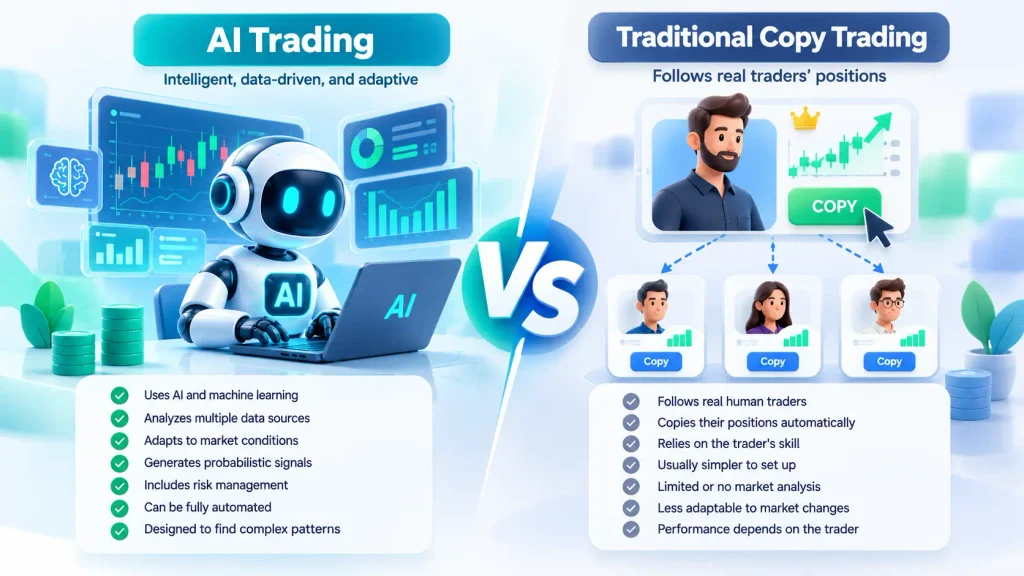
AI systems do not necessarily replace traditional trading concepts. In many cases, they automate or extend them.
| Feature | Traditional Analysis | AI-Based Analysis |
|---|---|---|
| Data processing | Primarily manual or rule-based | Can process large datasets automatically |
| Pattern detection | Human interpretation | Statistical or machine-learning detection |
| News analysis | Human reading | Can use NLP and automated text analysis |
| Signal generation | Trader-defined rules | Model-generated or model-assisted |
| Adaptability | Depends heavily on trader | Can be designed to update or adapt |
| Explainability | Often easier to understand | Can be difficult for complex models |
| Automation | Varies | Potentially very high |
| Model risk | Lower dependency on models | Greater dependency on data and models |
The distinction is therefore not simply “human versus machine.” Many modern trading workflows combine human judgment with algorithmic or AI-assisted tools.
AI Traders vs Algorithmic Trading
AI trading and algorithmic trading are related but not identical.
Algorithmic trading broadly refers to the use of computerized rules or models to generate and/or execute trading activity. A system can therefore be algorithmic without using machine learning.
For example, a rule stating “buy when the 20-day moving average crosses above the 50-day moving average” is algorithmic.
A machine-learning model that learns relationships from historical data to estimate the probability of a future price movement is more directly AI or ML-based.
Regulatory frameworks recognize the importance of controls around algorithmic trading. The FCA’s rules require appropriate systems and controls for algorithmic trading, including resilience, capacity, trading thresholds, prevention of erroneous orders, and testing.
Can AI Traders Predict Forex Prices?
AI traders can generate forecasts, but they cannot reliably know future forex prices.
This distinction is crucial.
A machine-learning model may estimate that a currency pair has a higher historical probability of moving in one direction under a particular combination of conditions. That does not mean the predicted movement must occur.
The CFTC warns that automated trading programs and AI-enabled bots cannot consistently predict the future, even when their rules or indicators have been tuned to historical market behavior.
Markets can change because of unexpected economic events, geopolitical developments, central-bank decisions, liquidity changes, or other factors that were not represented adequately in the model’s historical training data.
Why AI Forex Predictions Can Fail
Overfitting
Overfitting occurs when a model becomes too closely adapted to historical data and learns patterns that do not generalize to new market conditions.
A backtest may therefore look impressive while live performance is substantially weaker.
Changing Market Regimes
A strategy trained during low-volatility conditions may not behave the same way during a sudden market shock.
Historical relationships between currencies can also change.
Data Leakage
Data leakage occurs when information that would not have been available at the time of a historical decision accidentally enters the training process.
This can make a backtest appear much stronger than a realistic live implementation.
Poor Data Quality
Incorrect timestamps, missing data, bad price feeds, survivorship bias, or inconsistent economic datasets can affect model results.
Model Drift
As market behavior changes, the statistical relationships learned by an AI model can become less useful.
This is why an AI trading system should be monitored after deployment rather than treated as a static piece of software.
How AI Traders Handle Major Economic News
Major economic releases can create abrupt price movements in forex.
Examples include interest-rate decisions, inflation data, employment reports, and central-bank announcements.
An AI system may handle these periods in several ways.
Event-Aware Trading
The system can identify scheduled economic events and modify trading parameters before the release.
Volatility Adjustment
Expected volatility can be used to reduce position size or adjust risk thresholds.
News-Based Analysis
Natural-language processing can analyze headlines or statements and attempt to classify their potential market relevance.
Trading Suspension
A conservative strategy may simply stop opening new positions around high-risk events.
There is no universally correct approach. The appropriate design depends on the strategy, market, execution infrastructure, and risk tolerance.
How AI Traders Analyze Multiple Currency Pairs
Forex is interconnected.
A system analyzing EUR/USD does not necessarily treat that pair as an isolated asset.
It may also evaluate:
- USD/JPY
- GBP/USD
- USD/CHF
- AUD/USD
- USD/CAD
- Cross-currency relationships
Correlations can help models identify whether apparently different positions actually represent similar underlying exposure.
For example, holding several trades that all depend heavily on U.S. dollar weakness may create substantially more concentration than the number of open positions suggests.
Backtesting AI Forex Strategies
Before deploying an AI trading strategy with real capital, developers often test it against historical data.
Backtesting means simulating how a strategy would have behaved using historical information.
Important variables include:
- Entry and exit rules
- Transaction costs
- Spreads
- Slippage assumptions
- Execution timing
- Position sizing
- Leverage
- Risk limits
A credible backtest should attempt to approximate realistic trading conditions. A strategy that ignores spreads, slippage, or execution constraints can produce misleading results.
Forward Testing and Paper Trading
Backtesting alone is not enough.
Forward testing involves evaluating a strategy on new data that was not used during model development. Paper trading can then be used to observe how the system behaves without risking live capital.
This separation helps reduce the risk of confusing historical optimization with genuine predictive capability.
Professional algorithmic trading frameworks also place substantial importance on testing and controlled deployment. The FCA’s review of algorithmic trading controls highlighted practices including algorithm inventories, controlled deployment, testing, and pre- and post-trade risk controls.
What Are the Benefits of AI Forex Analysis?
Processing Speed
AI systems can process large datasets rapidly, which can be useful when many currency pairs and variables need to be evaluated simultaneously.
Consistency
A properly specified algorithm can apply the same analytical rules repeatedly without fatigue or emotional reactions.
Multi-Factor Analysis
AI can combine technical, fundamental, market-structure, and sentiment variables in one analytical workflow.
Continuous Monitoring
Automated systems can monitor markets continuously instead of depending on a trader being available at a particular moment.
Pattern Discovery
Machine-learning models can identify relationships that may be difficult to spot manually, particularly across large datasets.
These are potential technological advantages, not guarantees of trading performance.
Risks and Limitations of AI Traders
Model Risk
The model itself can be wrong. A technically sophisticated system may still produce incorrect signals.
Black-Box Behavior
Some complex machine-learning models can be difficult to interpret, making it harder to understand why a particular decision was generated.
Automation Risk
A software error can potentially turn an analytical mistake into an executed trade.
Data Risk
Incorrect or poorly structured data can contaminate the entire decision-making process.
Execution Risk
A model can generate a correct signal while real-world execution produces a different outcome because of spreads, slippage, latency, or liquidity conditions.
False Confidence
Perhaps the most important risk is psychological. A sophisticated-looking dashboard or an AI label can create an impression of certainty that the underlying model does not actually provide.
AI risk-management frameworks emphasize the need to identify, assess, and manage risks throughout the AI lifecycle rather than assuming that the presence of AI makes a system trustworthy automatically.
Forex Leverage Makes Risk Management Especially Important
Forex trading frequently involves leverage, which allows traders to control a larger position with a smaller amount of capital.
Leverage magnifies both gains and losses.
The CFTC warns that retail OTC forex customers can lose all of their margin and may, depending on the circumstances and applicable rules, face losses beyond the amount initially deposited. Its guidance also notes that most OTC forex customers lose money after credits, financing charges, fees, and other expenses are considered.
For an AI trading system, this makes position sizing and exposure limits particularly important.
A model that produces frequent signals without an appropriate risk layer can create excessive turnover or leverage even when individual signals appear reasonable.
How to Evaluate an AI Forex Trading System
1. Understand What the AI Actually Does
Ask whether the platform uses:
- Machine learning
- Rules-based algorithms
- Statistical models
- Natural-language processing
- Portfolio optimization
- A combination of these methods
A provider that simply says “powered by AI” without explaining the system’s function provides limited information for meaningful evaluation.
2. Examine the Testing Methodology
Find out whether performance results are based on:
- Backtesting
- Paper trading
- Live trading
- Out-of-sample testing
- Walk-forward testing
Also check whether fees, spreads, and realistic execution assumptions are included.
3. Look at Drawdown, Not Only Returns
A system with a high historical return may also have experienced substantial losses.
Review maximum drawdown, volatility, losing periods, leverage, and concentration alongside return figures.
4. Check Risk Controls
Look for maximum position sizes, exposure limits, stop-loss mechanisms, trading limits, and emergency controls.
Regulatory guidance concerning algorithmic trading emphasizes robust controls, testing, thresholds, and safeguards against erroneous or disorderly trading.
5. Verify the Provider
Regulation varies by country and product structure, but verification should be a basic part of due diligence.
For U.S. retail forex, the CFTC advises customers to research OTC forex dealers and verify registration and disciplinary history through the CFTC and NFA.
6. Investigate Withdrawal and Custody Conditions
Understand where funds are held, who the counterparty is, how withdrawals work, and what fees or restrictions apply.
The CFTC warns that fraudulent forex platforms can use withdrawal problems, additional payment demands, fake taxes, or other tactics to prevent customers from accessing their funds.
AI Forex Trading for Beginners
Beginners do not need to understand every neural-network architecture to evaluate an AI forex product.
A more practical process is to follow five steps.
Step 1: Learn the Forex Basics
Understand currency pairs, spreads, leverage, margin, order types, and volatility before relying on automation.
Step 2: Understand the AI’s Role
Determine whether the system analyzes data, generates signals, selects strategies, manages positions, or executes trades.
Step 3: Study the Risk Model
Check position limits, drawdown controls, leverage, stop-loss rules, and exposure limits.
Step 4: Review Evidence
Separate independently verifiable live results from simulations and marketing claims.
Step 5: Start With Appropriate Risk
Never assume automation makes an inherently leveraged market safe.
The CFTC recommends determining how much risk capital can be afforded for trading and avoiding money needed for essential expenses or savings.
Common Mistakes When Using AI Traders
Mistake 1: Treating AI as a Guaranteed Predictor
An AI model generates a forecast or classification, not certainty.
Better approach: Think in terms of probabilities, assumptions, and risk.
Mistake 2: Trusting Backtests Without Question
A backtest can be optimized until it looks impressive.
Better approach: Look for out-of-sample and forward-testing evidence.
Mistake 3: Ignoring Trading Costs
Spreads, financing costs, commissions, and slippage can change the economics of a strategy.
Better approach: Evaluate net performance after realistic costs.
Mistake 4: Using Excessive Leverage
Even a system with a strong historical signal can experience a losing streak.
Better approach: Keep leverage and position sizing consistent with an explicit risk framework.
Mistake 5: Believing Complex Technology Means Better Technology
A neural network is not automatically superior to a simpler statistical model.
Better approach: Evaluate predictive validity, robustness, transparency, and risk controls rather than technical complexity alone.
Mistake 6: Ignoring Model Drift
A model can gradually become less effective as market behavior changes.
Better approach: Monitor performance and retraining requirements continuously.
Can AI Traders Outperform Human Forex Traders?
There is no universal answer.
AI systems can process information at high speed and apply rules consistently, while experienced human traders can incorporate context that is difficult to encode into a model.
The two approaches also differ in their failure modes.
A human may miss information, make an emotional decision, or react inconsistently. An AI model may systematically repeat an incorrect assumption across thousands of trades.
Therefore, performance should be evaluated at the level of the specific strategy and implementation rather than through a general claim that AI or humans are inherently superior.
AI Traders and Forex Market Microstructure
Advanced AI trading systems may also analyze elements of market microstructure.
Market microstructure concerns how orders, liquidity, prices, spreads, and execution interact.
For a short-term trading system, these factors can matter as much as the broader market direction.
For example, a model may identify a potentially favorable signal but determine that the current spread or liquidity conditions make execution unattractive.
In that situation, the model may delay the trade, reduce position size, or avoid execution entirely.
This highlights an important difference between analysis and actual trading: a correct market prediction does not automatically translate into a profitable trade.
AI Traders and Explainability
Explainability becomes increasingly important as trading systems become more complex.
A simple moving-average strategy can be explained in one sentence. A complex machine-learning model may combine hundreds of variables in a way that is much harder to interpret.
For users and operators, useful questions include:
- Why did the system generate this signal?
- Which variables influenced the decision?
- How confident was the model?
- What changed from the previous signal?
- Which risk constraints were applied?
- What happens when data quality deteriorates?
Explainability can therefore be an important component when evaluating an AI trading system, particularly when automated decisions can directly affect financial positions.
Regulatory and Operational Considerations
AI forex trading exists within the broader regulatory framework governing financial services, markets, automated trading, and retail forex.
The exact requirements depend on the jurisdiction, product, platform, and activity.
In the UK, FCA requirements for algorithmic trading include resilient systems, sufficient capacity, appropriate thresholds and limits, controls to prevent erroneous orders, and appropriate testing.
The FCA’s review of algorithmic trading controls also emphasized algorithm inventories, controlled deployment, pre- and post-trade controls, governance, and testing as important elements of algorithmic trading oversight.
For U.S. retail forex customers, the CFTC advises verifying the registration and disciplinary history of relevant dealers and professionals before depositing funds.
Regulatory status should therefore be evaluated for the actual provider and service rather than inferred from terms such as “AI,” “automated,” or “institutional-grade.”
Warning Signs of an AI Forex Trading Scam
Be particularly cautious when a platform combines AI terminology with promises such as:
- Guaranteed profits
- Zero-risk forex trading
- Fixed daily returns
- Extremely high win rates
- “Never loses” algorithms
- Secret technology that supposedly eliminates market risk
- Pressure to deposit immediately
- Unclear company ownership
- Unregistered offshore dealers
- Unexpected withdrawal fees or taxes
The CFTC warns about forex scams that promise unusually high returns with little or no downside risk and advises customers to verify firms and professionals before trading.
The regulator also warns that AI-enabled trading bots cannot consistently predict the future.
Practical Example: How an AI Trader Could Analyze EUR/USD
Imagine an AI trading system evaluating EUR/USD before the European and U.S. trading sessions.
First, it collects recent price history, volatility measures, technical indicators, and information about the current spread.
Next, it evaluates scheduled economic events, such as inflation or employment data, and analyzes relevant news or central-bank statements.
The model then compares current conditions with historical patterns. It may classify the market as trending, range-bound, high-volatility, or otherwise unsuitable for the strategy.
Suppose the model generates a bullish probability estimate. That still does not automatically mean a large long position should be opened.
The risk layer might determine that volatility is too high, or that a major economic announcement is imminent. It could therefore reduce the position size or avoid the trade.
This example illustrates the broader principle behind AI forex analysis:
AI trading is not just about predicting direction. It is about processing information, estimating probabilities, and deciding how much risk to take under defined conditions.
Conclusion
AI traders analyze the forex market by combining large amounts of market, economic, technical, and sometimes textual data with computational models that identify patterns, estimate probabilities, detect market conditions, and support trading decisions.
The analysis can involve technical indicators, fundamental data, market sentiment, volatility, liquidity, currency correlations, and historical price relationships. More advanced systems can also use machine learning to detect market regimes and dynamically adjust their behavior.
However, AI does not eliminate uncertainty. A model can overfit historical data, rely on poor information, fail when market conditions change, or produce a correct forecast that still results in a losing trade because of execution and risk-management problems.
For that reason, evaluating an AI forex system requires more than looking at its claimed accuracy or historical return. The methodology, data, testing process, leverage, drawdown, execution assumptions, risk controls, regulatory status, and provider’s transparency all matter.
The most useful way to think about AI in forex is not as a machine that knows what the market will do next, but as a technology for processing information, finding statistical relationships, and executing decisions according to a defined framework.
That distinction is essential when assessing any AI trading system, especially in a leveraged and highly dynamic market such as forex.
Sources
- CFTC – Eight Things You Should Know Before Trading Forex
- CFTC – Forex Frauds
- CFTC – Check Registration & Backgrounds Before You Trade
- FCA – Algorithmic Trading Controls: High-Level Observations
- FCA Handbook – Algorithmic Trading Requirements
- BIS – Harnessing Artificial Intelligence for Monitoring Financial Markets
- NIST – Artificial Intelligence Risk Management Framework