
AI has introduced a new layer of automation to trading. Instead of simply copying the trades of another investor, an AI-powered system may analyze market data, evaluate traders, adjust portfolio allocations, or combine multiple signals before executing a strategy.
That creates an important distinction between AI copy trading and traditional copy trading.
Traditional copy trading generally revolves around following another trader: when that trader opens, modifies, or closes a position, the copying account can automatically reproduce the activity according to the platform’s rules. The UK’s Financial Conduct Authority describes copy trading as automatically copying another investor’s trades and notes that, in some circumstances, it can fall within portfolio or investment management.
AI copy trading adds another decision-making layer. Instead of relying exclusively on a human trader’s actions, an AI or machine-learning system may evaluate data, traders, strategies, market conditions, or portfolio risk before deciding what to copy or how much to allocate.
The distinction matters because automation does not necessarily mean artificial intelligence, and using the label “AI” does not automatically make a trading system more sophisticated, accurate, or profitable.
This guide explains how both approaches work, where they differ, what risks they share, and what investors should evaluate before using either one.
What Is AI Copy Trading?
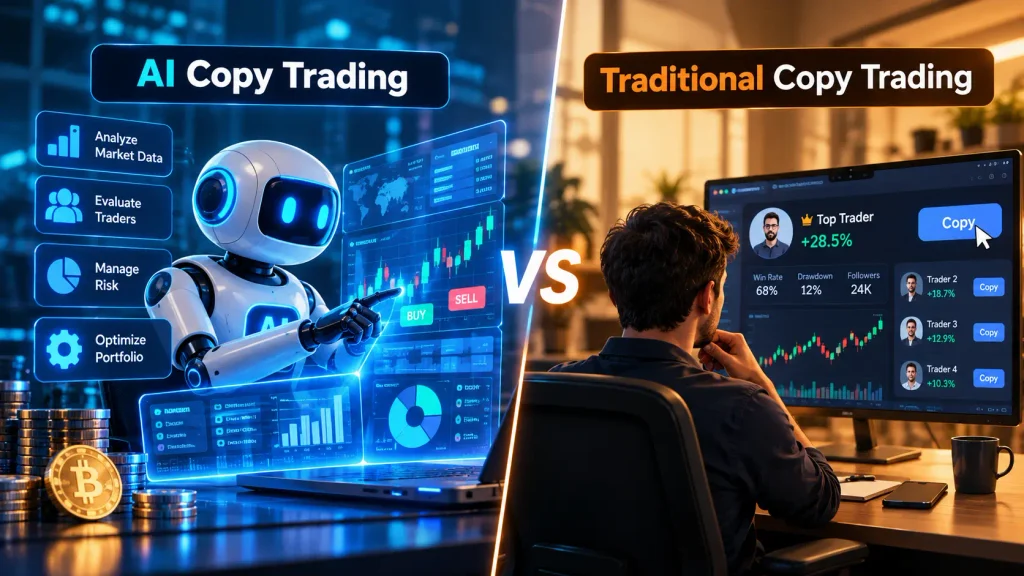
AI copy trading is an automated trading approach in which artificial intelligence or machine-learning techniques are used to analyze traders, strategies, market data, or portfolio conditions and help determine which trades or trading strategies should be copied.
Traditional copy trading primarily follows a selected trader. AI copy trading can introduce additional analysis and decision-making between the trader’s activity and the user’s final portfolio allocation.
The exact implementation varies considerably between platforms. An “AI” system could analyze historical trader behavior, volatility, drawdowns, correlations, market conditions, or other datasets. More advanced systems may dynamically adjust position sizes or decide when a signal should or should not be followed.
AI itself is a broad term. NIST describes AI in terms that include machine-based systems capable of making predictions, recommendations, or decisions based on human-defined objectives. Machine learning is a related approach in which systems adapt and learn from data.
That means AI copy trading should not be treated as a single standardized technology. Two platforms can both advertise “AI trading” while using very different models, datasets, risk controls, and levels of automation.
What Is Traditional Copy Trading?
Traditional copy trading allows an investor to automatically replicate the trades of another trader.
For example, imagine a trader named Alex opens a Bitcoin position. A copy-trading platform may automatically open a corresponding position in another user’s account based on the amount the user has allocated to Alex.
When Alex changes or closes the position, the copying account may execute corresponding changes.
The FCA describes this basic structure as selecting a third-party signal provider and authorizing the platform to transform those signals into buy or sell orders without further intervention from the client.
The core decision therefore comes from the human trader being copied.
The platform provides the infrastructure that connects the signal provider and follower, while the investor typically decides:
- Which trader to copy
- How much capital to allocate
- Whether to use risk controls
- When to stop copying
- Which assets or markets to access
Traditional copy trading is consequently closer to delegating trade selection to another trader, while AI-enabled systems can delegate part of the analysis or allocation process to a computational model.
How Does AI Copy Trading Work?
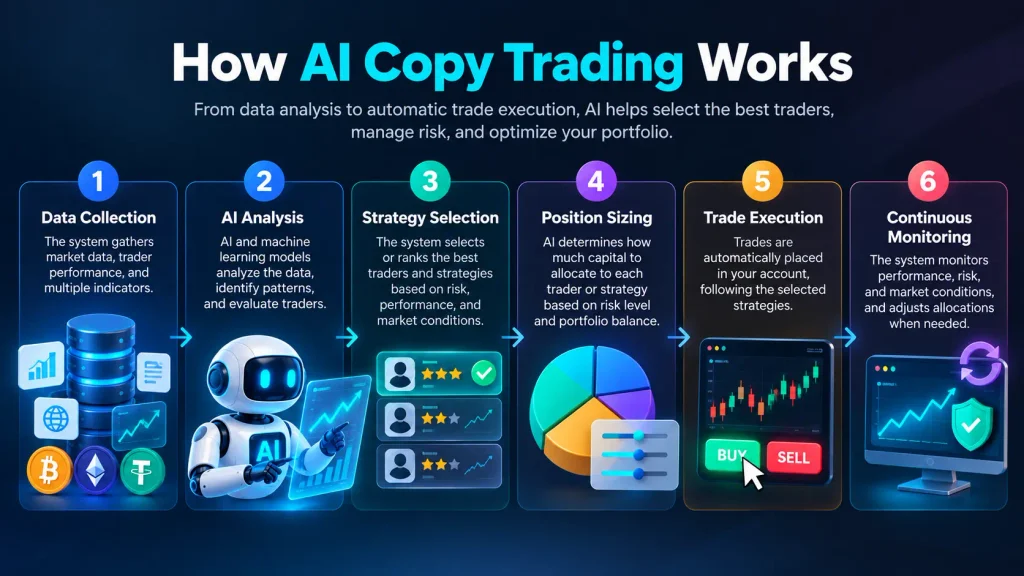
Although implementations differ, an AI copy trading workflow can generally be divided into several stages.
1. Data Collection
The system first receives data.
Depending on the platform, this could include:
- Historical trading activity
- Trader performance
- Drawdown
- Volatility
- Trading frequency
- Asset exposure
- Market prices
- Trading volume
- Technical indicators
- Portfolio correlations
- Other market or behavioral data
The quality and relevance of that data matter significantly. Poor, incomplete, outdated, or insufficiently validated data can affect model outcomes.
2. Model Analysis
The AI system processes the available information.
A model might attempt to identify patterns such as:
- Which traders have maintained consistent risk-adjusted performance
- Whether a trader’s results depend heavily on one asset
- Whether a strategy becomes unstable during high volatility
- Whether several traders are effectively making the same bets
- Whether recent behavior differs substantially from historical behavior
The model may use machine learning, statistical models, rules, or a combination of techniques.
3. Trader or Strategy Selection
An AI system may then determine which traders or strategies should be considered for copying.
For instance, instead of choosing the trader with the highest historical return, an AI-driven process might also consider drawdown, volatility, correlation, trading frequency, or changing market conditions.
This is an important conceptual difference.
Traditional copy trading often starts with:
“Which trader do I want to copy?”
An AI-assisted approach may instead ask:
“Which strategy or combination of strategies currently fits the defined objectives and risk constraints?”
4. Position Sizing
The system may determine how much capital should follow a signal.
For example, two traders could generate equally attractive signals but receive different allocations because one has historically exhibited substantially higher volatility.
Position sizing is particularly important because copying a trade does not automatically reproduce the same level of risk.
5. Trade Execution
Once a decision is generated, the platform may automatically place trades.
Execution can introduce practical differences between the original trader and the follower, including:
- Slippage
- Spread
- Execution delay
- Different liquidity
- Minimum order sizes
- Platform fees
A profitable original trade therefore does not guarantee an identical result for the copying account.
6. Continuous Monitoring
More sophisticated systems may monitor the portfolio after execution.
The system could reassess:
- Market conditions
- Portfolio exposure
- Trader behavior
- Drawdown
- Volatility
- Correlation
- Risk thresholds
This allows the process to be more dynamic than simply copying every trade one-for-one.
AI Trading vs Traditional Copy Trading
The fundamental difference is where the trading decision comes from.
Traditional copy trading primarily follows the activity of another trader.
AI trading can use algorithms or machine-learning systems to generate, filter, rank, or modify trading decisions.
AI copy trading combines these ideas: the system can use AI to determine which human-generated signals to follow, how to weight them, or when to reduce exposure.
| Feature | Traditional Copy Trading | AI Copy Trading |
|---|---|---|
| Primary decision source | Human trader | AI system, often combined with human signals |
| Main function | Replicate selected trades | Analyze, filter, rank, or adapt trades |
| Trader selection | Usually user-driven | May be AI-assisted |
| Position sizing | Often preset or proportional | May be dynamically calculated |
| Market analysis | Mainly performed by copied trader | May also be performed by model |
| Automation | High | High |
| Human oversight | User selects trader | Depends on platform design |
| Adaptability | Depends on copied trader | May dynamically respond to data |
| Transparency | Usually easier to understand | Can be harder to explain |
| Model risk | Lower model dependency | Greater model and data dependency |
| Key risk | Following the wrong trader | Model failure, bad data, or wrong trader selection |
| Complexity | Generally simpler | Potentially more complex |
Neither approach eliminates investment risk.
Instead, the source and structure of the decision-making process change.
AI Copy Trading vs Algorithmic Trading
These concepts are related but not interchangeable.
Algorithmic trading generally refers to automatically generating and executing orders according to computational rules or models. A system can be algorithmic without using machine learning.
AI trading is a subset or adjacent category depending on how “AI” is defined. For example, a system that follows predefined rules is algorithmic, while a machine-learning model can use historical data to estimate patterns or probabilities.
For example:
- “Buy Bitcoin if the 50-day moving average crosses above the 200-day moving average” is algorithmic.
- A machine-learning model estimating the probability of a market move is AI or ML-based.
- Automatically copying another trader is copy trading.
- An AI system deciding which trader to copy combines AI with copy trading.
Understanding this distinction is important because marketing materials sometimes use AI, automated trading, algorithmic trading, and copy trading as if they were synonyms.
They are not.
What Are the Potential Benefits of AI Copy Trading?
Faster Data Processing
A computational model can process large datasets much faster than a person can manually review them.
This may be useful when a platform evaluates multiple traders, markets, and historical variables simultaneously.
Reduced Emotional Decision-Making
Traditional trading can be affected by emotions such as fear, greed, loss aversion, or overconfidence.
Automated systems do not experience those emotions in the human sense. A properly designed system can therefore apply predefined rules consistently.
However, automation does not remove human bias entirely. Bias can enter through the data selected, model objectives, risk parameters, trader-selection rules, and system design.
Dynamic Portfolio Allocation
AI systems can potentially modify allocations as conditions change.
For example, a system could reduce the allocation to a trader whose recent drawdown or volatility has changed significantly.
Whether this actually improves outcomes depends on the model and implementation.
Multi-Trader Analysis
A user might manually compare dozens of traders. An AI system can potentially evaluate a much larger set of variables across a portfolio.
This can make it easier to identify correlations and concentration risks that are not immediately visible from individual trader profiles.
Automation
Both traditional and AI copy trading can reduce the need for manually entering every trade.
However, automation does not automatically mean better performance or lower risk.
Risks and Limitations of AI Copy Trading
AI Cannot Reliably Predict the Future
A machine-learning model can identify statistical relationships in historical or current data, but that does not mean it can reliably predict future market movements.
Unusual conditions, extreme volatility, geopolitical events, or other circumstances outside the training data can cause AI models used for trading to produce unreliable predictions and potentially unwanted trading behavior.
Model Risk
A model may simply be wrong.
Possible causes include:
- Poor assumptions
- Incorrect parameters
- Incomplete data
- Overfitting
- Data leakage
- Changing market regimes
- Programming errors
- Incorrect risk thresholds
Data Quality
AI systems are only as useful as the information they process.
If a platform relies on inaccurate, outdated, manipulated, or incomplete data, its output may also be unreliable.
This makes it important to understand, at least at a high level:
- Where the data comes from
- How frequently it is updated
- Whether historical data has been adjusted
- How the model is tested
- Whether the system is monitored after deployment
Overfitting
An AI system can sometimes perform exceptionally well on historical data because it has effectively adapted to patterns that do not persist.
This is known as overfitting.
A strategy that looks excellent in backtesting may therefore perform very differently in live markets.
Black-Box Decisions
Some AI systems are difficult to interpret.
A user may see that an AI assigned 35% of a portfolio to one trader and 10% to another without understanding precisely why.
This creates an explainability problem.
Risks Shared by AI and Traditional Copy Trading
Not every risk comes from artificial intelligence.
Market Risk
Copied or AI-selected trades can lose money.
Trader Selection Risk
A trader’s previous performance does not guarantee future results.
Concentration Risk
Copying several traders who all trade the same assets may create the illusion of diversification while maintaining substantial exposure to the same underlying market.
Execution Risk
The follower may receive a different entry or exit price than the original trader.
Fee Risk
Trading fees, spreads, subscription fees, performance fees, or other charges can reduce net returns.
Platform Risk
Users must consider what happens if the platform experiences technical problems, changes its terms, becomes unavailable, or fails to execute an instruction.
Is AI Copy Trading Safe?
There is no universal answer because “AI copy trading” describes a category of technologies rather than one standardized product.
A platform can use sophisticated AI while still having poor risk controls. Another platform can use relatively simple automation but provide clearer disclosures and stronger operational controls.
Regulators have warned against treating AI marketing as evidence of investment quality.
Authorities including the SEC, NASAA, and FINRA have warned that fraudsters may use the popularity of AI to promote unregistered platforms and unrealistic claims, including promises that proprietary AI systems cannot lose or can generate extraordinary returns.
The CFTC has likewise warned that AI does not turn trading bots into guaranteed money-making machines and advises investors to investigate companies, understand underlying asset risks, and consider fees and spreads.
A useful principle is therefore:
Evaluate the trading system, not the AI label.
How to Evaluate an AI Copy Trading Platform
1. Identify What “AI” Actually Means
Ask:
- Does the platform use machine learning?
- Is it simply rule-based automation?
- Does AI select traders?
- Does AI modify position sizing?
- Does it generate its own signals?
- Does a human review the output?
A vague description such as “proprietary AI technology” is not enough to establish how the system operates.
2. Investigate Historical Performance Carefully
Do not focus only on total return.
Also examine:
- Maximum drawdown
- Volatility
- Number of trades
- Holding period
- Worst historical period
- Leverage
- Asset concentration
- Consistency
A strategy can have a high return while also exposing investors to substantial downside risk.
3. Check Fees and Execution Costs
Look beyond the headline subscription price.
Consider:
- Trading commissions
- Spreads
- Withdrawal fees
- Performance fees
- Management fees
- Slippage
- Minimum balances
- Conversion costs
Small recurring expenses can materially affect net results.
4. Verify Registration and Authorization
Regulatory requirements vary by country and by the services offered.
In the EU, ESMA has issued supervisory guidance concerning copy trading services, including areas such as costs and charges, product governance, suitability and appropriateness, remuneration, and the qualifications of copied traders.
For crypto assets, the regulatory treatment can depend on the exact service being provided and the applicable jurisdiction.
The exact regulatory position depends on jurisdiction, asset class, platform structure, and the service being provided.
5. Look for Risk Controls
Useful controls can include:
- Maximum allocation
- Stop-loss parameters
- Maximum drawdown limits
- Exposure limits
- Position-size limits
- Trading suspension rules
- Manual override
- Emergency shutdown
AI Copy Trading for Beginners
Someone new to automated investing does not need to understand every machine-learning architecture before evaluating a platform.
A more practical approach is to proceed systematically.
Step 1: Understand the Underlying Assets
Know what you are actually trading.
Stocks, forex, CFDs, futures, and crypto assets have different risk characteristics and regulatory frameworks.
Step 2: Understand the Mechanism
Determine whether the system:
- Copies a human trader
- Generates independent signals
- Filters human signals using AI
- Dynamically allocates among traders
- Executes trades automatically
Step 3: Examine the Risk Profile
Do not select a system solely because its historical return looks attractive.
Look at drawdown, volatility, leverage, concentration, and losing periods.
Step 4: Use an Appropriate Amount of Risk
Automation does not protect capital from market losses.
Your position size should be determined by your financial circumstances and risk tolerance, not by the platform’s promotional claims.
Step 5: Monitor the System
Automation does not mean “set it and forget it.”
Review whether the platform, trader, strategy, fees, and risk profile remain consistent with your original objectives.
Common Mistakes With AI Copy Trading
Mistake 1: Assuming AI Means Higher Returns
AI is a technology, not a performance guarantee.
Regulatory authorities have warned investors to be skeptical of claims that AI trading systems can guarantee high returns or eliminate risk.
Better approach: Evaluate evidence, methodology, costs, risk controls, and independently verifiable performance.
Mistake 2: Choosing the Trader With the Highest Return
High historical returns can result from high leverage or concentrated risk.
Better approach: Examine drawdown, volatility, leverage, consistency, and exposure.
Mistake 3: Ignoring Correlation
Following five traders does not necessarily mean you have five independent strategies.
If all five heavily trade Bitcoin, for example, a Bitcoin decline can affect the entire portfolio.
Better approach: Analyze underlying asset exposure.
Mistake 4: Trusting Backtests Blindly
A backtest is a historical simulation.
It does not recreate every condition of live trading.
Better approach: Look for out-of-sample testing, realistic costs, and live performance where available.
Mistake 5: Ignoring Withdrawal Conditions
A platform showing a growing account balance is not sufficient evidence that funds can actually be withdrawn.
Some investment scams display supposed profits and later demand additional fees, taxes, or deposits before allowing withdrawals.
Better approach: Verify the platform and understand withdrawal procedures before committing substantial funds.
Advanced Considerations
Human Trader vs AI Decision-Making
A copied human trader may incorporate contextual information that is difficult to encode into a model.
Conversely, an AI system can analyze large amounts of structured data without becoming tired, distracted, or emotionally attached to a position.
Both approaches have failure modes.
The important question is therefore not whether humans or machines are universally superior, but what decision-making system is actually being used and what controls surround it.
Adaptive Models
Some AI systems can update their behavior as new information becomes available.
This may provide adaptability, but it can also create a governance challenge.
If the model changes over time, users should understand how the provider validates those changes and prevents unexpected behavior.
Model Drift
Market conditions can change.
A strategy trained on one market regime may behave differently when volatility, liquidity, interest rates, correlations, or market structure change.
This makes ongoing monitoring important.
AI Herding
If multiple AI systems use similar datasets or signals, they may independently arrive at similar decisions.
This could potentially contribute to herd behavior or unpredictable outcomes.
AI Trading vs Traditional Copy Trading: Which Approach Fits Different Users?
There is no universal choice.
A person who wants to follow a particular trader’s decisions and keep the mechanism relatively simple may prefer traditional copy trading.
Someone looking for automated analysis, dynamic allocation, or model-based filtering may be interested in AI-enabled systems.
An experienced trader might instead want greater control over the underlying strategy and use AI as an analytical tool rather than delegating the complete decision-making process.
The key distinction is the degree and location of automation.
Traditional copy trading generally automates the replication of another trader’s activity.
AI copy trading can automate additional decisions around selection, filtering, portfolio construction, or execution.
AI Copy Trading and Regulation
Regulation is especially important because automated trading can sit across several regulatory categories depending on the asset and service.
In the EU, ESMA’s guidance on copy trading under the EU investment-services framework addresses issues including investor information, charges, product governance, suitability and appropriateness, remuneration, and the qualifications of copied traders.
In the UK, the FCA states that copy trading may be classified as portfolio or investment management where there is no clear manual input by the account holder.
Crypto introduces another layer of complexity. The regulatory treatment of copy or auto-trading services depends on the particular services being provided and the applicable legal framework.
For users, seeing the word “regulated” on a website is therefore not enough. The relevant questions include:
- Who is regulated?
- By which authority?
- For which activity?
- In which jurisdiction?
- Which entity holds customer assets?
- What protections apply?
- What products are actually covered?
How AI Copy Trading Can Go Wrong: A Practical Example
Consider an AI copy-trading platform that identifies a trader who generated a 60% return over the previous year.
A traditional copy trader might decide to follow that person and automatically reproduce their positions.
An AI-enabled system might go further and analyze the trader’s historical volatility, drawdowns, asset allocation, and recent performance before determining whether and how heavily to copy the trader.
Now suppose the trader’s performance came largely from a highly leveraged position during an unusually favorable market environment.
The historical return may look impressive, but the underlying risk could be substantially higher than it initially appears.
An AI model that properly incorporates leverage and drawdown might reduce exposure.
But a poorly designed model—or one using incomplete data—could still assign too much capital.
This example illustrates an important point:
AI can change the decision process, but it cannot remove the underlying market risk.
Warning Signs of an AI Trading Scam
Extra caution is warranted when a platform uses AI terminology together with claims such as:
- Guaranteed returns
- Zero-risk trading
- Guaranteed monthly profits
- “Cannot lose” systems
- Extremely high win rates
- Secret proprietary technology with no meaningful explanation
- Pressure to deposit immediately
- Unclear company ownership
- Unverified executives
- Unusually complicated withdrawal rules
Regulatory authorities have specifically warned that fraudulent investment schemes may use AI terminology and unrealistic promises to attract investors.
AI branding should therefore increase your questions, not eliminate them.
Conclusion
AI copy trading and traditional copy trading are related but distinct concepts.
Traditional copy trading primarily automates the replication of another trader’s decisions.
AI copy trading introduces artificial intelligence or machine-learning techniques that may analyze traders, strategies, market data, risk, or portfolio allocation before or during the copying process.
The additional technology can potentially provide more sophisticated filtering, allocation, and monitoring. At the same time, it introduces additional risks involving model quality, data integrity, explainability, model drift, cybersecurity, and autonomous decision-making.
The most important lesson is that AI is not a synonym for profitable or safe trading.
A responsible evaluation should focus on the actual mechanism, historical and live performance evidence, drawdown, leverage, fees, execution, risk controls, regulatory status, custody arrangements, and withdrawal conditions.
For investors comparing AI copy trading with traditional copy trading, the right question is not simply:
“Which one uses better technology?”
It is:
“How does this system make decisions, what risks does it introduce, and can I independently verify how it operates?”
That question remains useful regardless of the platform, asset class, or AI model involved.
Frequently Asked Questions
What is AI copy trading?
AI copy trading is an automated trading approach that uses artificial intelligence or machine-learning techniques to analyze traders, market data, strategies, or portfolio risk and help determine which trades or strategies should be copied.
How does AI copy trading work?
An AI copy trading system can collect trader and market data, analyze performance and risk, select or rank traders, determine allocation, execute trades automatically, and continuously monitor the portfolio.
What is the difference between AI trading and traditional copy trading?
Traditional copy trading primarily replicates the trades of a selected human trader. AI trading can use algorithms or machine-learning models to generate, filter, rank, or modify trading decisions. AI copy trading can combine both approaches.
Is AI copy trading profitable?
AI copy trading can generate gains or losses depending on the underlying strategies, assets, market conditions, execution, fees, and system design. AI technology does not guarantee profits.
Is AI copy trading safe?
There is no universal safety level for AI copy trading. Users should evaluate the platform, regulatory status, custody arrangements, fees, risk controls, historical performance, withdrawal terms, and claims made about the technology.
Can AI predict the stock or crypto market?
AI systems can analyze data and identify patterns, but they cannot reliably predict all future market movements. Unexpected events and market conditions outside a model’s training data can cause unreliable outputs.
What are the biggest risks of AI copy trading?
Major risks include market losses, model failure, poor data, overfitting, changing market conditions, concentration, execution differences, fees, platform risk, cybersecurity, and fraudulent AI claims.
Is AI copy trading better than traditional copy trading?
The two approaches solve different problems. Traditional copy trading focuses on replicating another trader, while AI copy trading may add automated analysis, selection, allocation, or risk filtering. Suitability depends on the user’s objectives and the platform’s design.
What should I check before using an AI trading platform?
Check the platform’s legal entity, regulatory status, fees, custody arrangements, withdrawal policies, risk controls, trading methodology, historical performance, drawdowns, leverage, and whether its claims about AI can be independently verified.
Does AI copy trading use machine learning?
Some AI copy trading systems may use machine learning, while others may use statistical models, predefined rules, or combinations of technologies. The term “AI” does not describe one standardized architecture.
Can AI copy trading be used for cryptocurrency?
Yes, AI and automated copy-trading mechanisms can be applied to crypto markets. However, regulatory treatment varies by jurisdiction and service, so users should verify the applicable rules and the provider’s authorization.
Sources
- FCA – Copy Trading
- ESMA – Guidance for Supervision of Copy Trading Services
- ESMA – Crypto-Asset Copy Trading and Auto Trading under MiCA
- FINRA – AI Applications in the Securities Industry
- FINRA – Key Challenges and Regulatory Considerations for AI
- Investor.gov – Artificial Intelligence (AI) and Investment Fraud
- CFTC – AI Won’t Turn Trading Bots into Money Machines
- NIST – Artificial Intelligence (AI) Glossary
- FCA – Financial Services Register