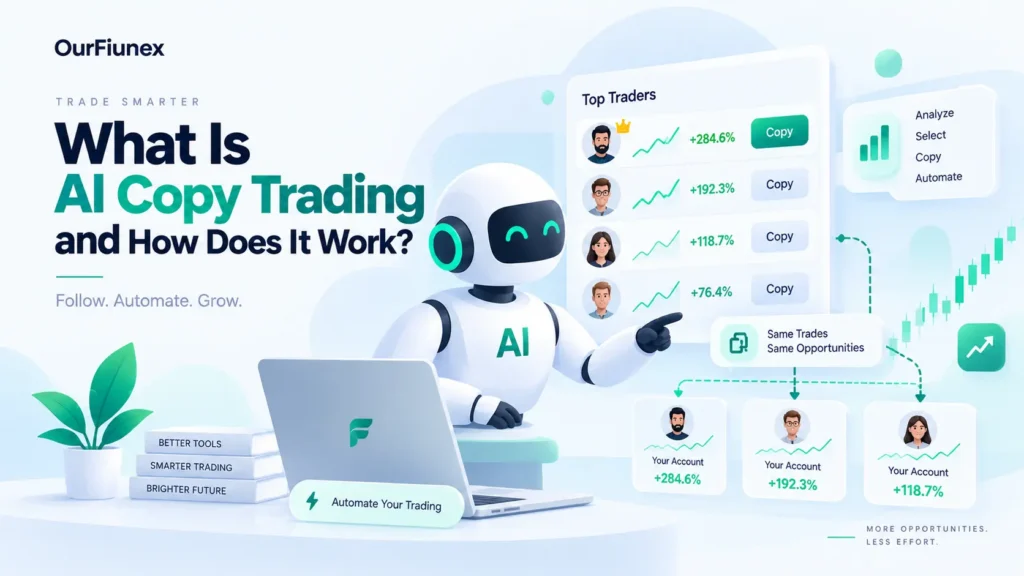
AI copy trading platform combines copy trading with artificial intelligence or machine-learning tools to help identify, analyze, rank, monitor, or execute trading strategies. Instead of making every trade manually, an investor may automatically replicate another trader’s positions, follow signals generated by an algorithm, or use AI-based tools to help decide which strategies to follow.
The important distinction is that AI copy trading is not one standardized technology. Depending on the platform, “AI copy trading” may mean an AI system selects traders to copy, an AI model generates the trades being copied, or AI is used for risk management and portfolio allocation around an existing copy-trading system.
Copy trading itself is well established. The UK’s Financial Conduct Authority describes copy trading as a process where investors automatically copy another investor’s trades and notes that, in some circumstances, copy trading can amount to portfolio or investment management.
The technology can reduce the amount of manual work required, but it does not remove market risk. A copied strategy can lose money, an AI model can make poor decisions, and automated execution can magnify losses when leverage or position sizing is too aggressive.
How Does AI Copy Trading Work?
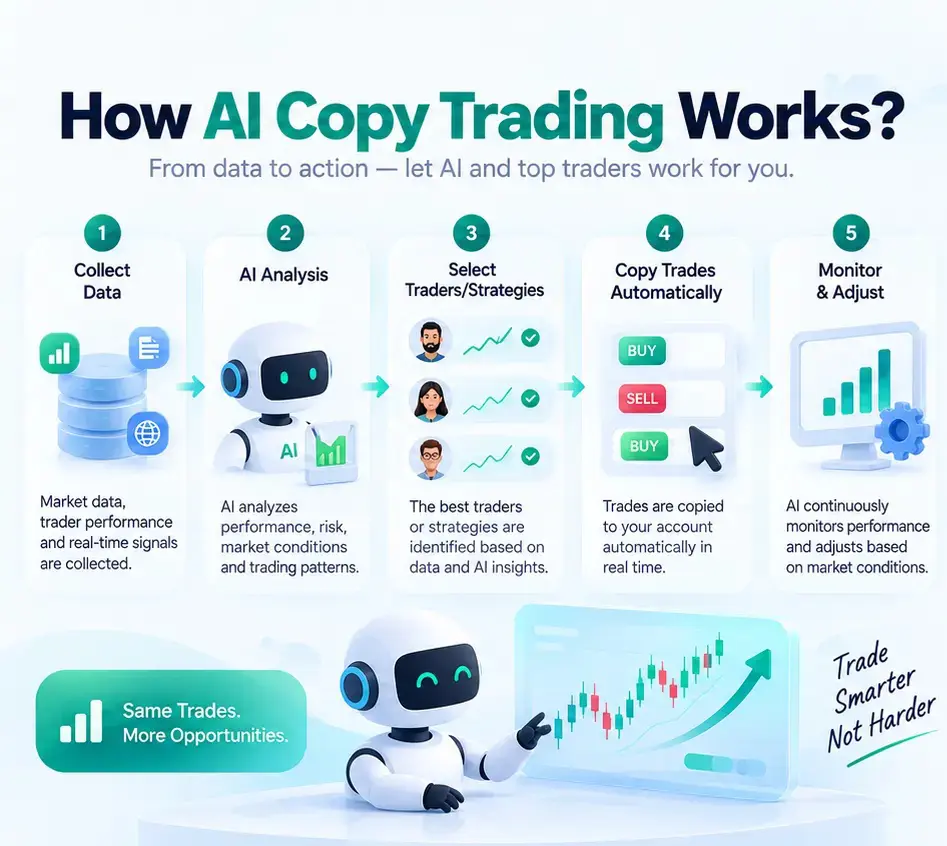
A typical AI copy-trading system has several layers:
- Market and account data are collected.
- AI or quantitative models analyze information.
- Traders, signals, or strategies are evaluated.
- The system decides whether and how to copy a trade.
- The trade is transmitted to the user’s account.
- Risk controls determine position size, stops, or exposure.
- Performance is monitored and the strategy may be adjusted.
The exact architecture varies considerably.
For example, a simple copy-trading system might do nothing more than replicate a provider’s buy and sell orders. An AI-assisted platform could additionally analyze historical performance, volatility, drawdown, correlation between traders, and other variables before allocating capital.
An advanced system might use machine learning to classify market conditions and determine whether a particular trading strategy should be followed at a given time.
A Simple Example
Imagine a trader whose account generates a buy order for EUR/USD.
In ordinary copy trading, the platform receives that event and creates a corresponding position in the follower’s account, subject to the platform’s allocation and risk settings.
With an AI-assisted system, an additional layer might evaluate factors such as:
- the provider’s recent drawdown
- market volatility
- current exposure
- the relationship between this trader and other followed traders
- the system’s historical behavior in similar market conditions
The AI layer may then influence whether the trade is copied, how large the position should be, or whether the investor’s exposure should be reduced.
That sounds sophisticated, but sophistication does not automatically mean better performance.
What Is Copy Trading ?
Copy trading is a form of automated trading in which one account replicates the trades of another trader or signal provider. Depending on the platform, trades may be copied proportionally according to account size, fixed amounts, or other allocation rules.
MetaTrader’s Signals service, for example, is designed to automatically copy trading operations from signal providers to subscriber accounts, with performance statistics and trading history available for evaluation.
Copy Trading vs. Social Trading
These terms are related but not identical.
| Feature | Copy Trading | Social Trading |
|---|---|---|
| Primary purpose | Automatically replicate trades | Share and discuss trading ideas |
| Automatic execution | Usually yes | Not necessarily |
| Trader profiles | Common | Common |
| Community features | Sometimes | Usually central |
| Manual decision-making | Reduced | Often significant |
| Main benefit | Automation | Information and interaction |
Social trading can include news feeds, trader discussions, rankings, ideas, and signals. Copy trading is more specifically about automatically reproducing trading activity.
How Are Traders Selected for Copy Trading?
This is one of the most important questions because the quality of the copied trader or strategy often matters more than the convenience of the platform.
A copy-trading service may show metrics such as:
- historical return
- drawdown
- number of trades
- average trade duration
- win rate
- risk level
- leverage
- trading frequency
- account age
- asset classes traded
An AI-assisted system may attempt to go further by analyzing patterns across these metrics.
However, historical performance has major limitations.
A trader who generated strong returns during a low-volatility period may perform very differently during a major market shock. Likewise, a strategy with an impressive return may have achieved it by taking substantially more risk than the headline number suggests.
Look Beyond Return
Suppose Strategy A gained 40% but experienced a 35% drawdown.
Strategy B gained 22% with a 7% drawdown.
Looking only at return makes Strategy A appear more attractive. Looking at the complete risk profile produces a very different picture.
That is why serious evaluation should consider both return and risk.
What Is AI Trading?
AI trading refers to the use of artificial intelligence techniques to analyze financial data, identify patterns, assist with decisions, optimize execution, or automate parts of a trading process.
AI can include several different technologies.
Machine Learning
Machine learning systems identify relationships in data rather than relying exclusively on manually written rules.
A model might process:
- historical prices
- volume
- volatility
- market indicators
- order-book information
- news
- economic data
- alternative data
The model can then generate a prediction, classification, probability, or signal.
Natural Language Processing
Natural language processing, or NLP, can analyze written information such as:
- financial news
- earnings releases
- company filings
- analyst reports
- social media
- central-bank communications
The objective may be to extract information that could be relevant to an investment or trading process.
AI for Execution
AI does not necessarily have to predict prices.
It can also be used to improve execution, such as determining how or when to place orders.
FINRA notes that firms are exploring AI for portfolio management and trading, including applications involving pattern identification, price-related predictions, smart order routing, price optimization, best execution, and allocation decisions.
What Is an AI Trading Bot?
An AI trading bot is software that uses automated rules, statistical models, machine learning, or other AI techniques to analyze market information and potentially execute trades.
The term is often used loosely.
A bot marketed as “AI-powered” might actually use:
- fixed technical indicators
- predefined trading rules
- statistical models
- machine learning
- reinforcement learning
- combinations of several models
So the label AI trading bot is not enough to evaluate a product.
A legitimate evaluation should ask:
- What model does it use?
- What data does it consume?
- What decisions does the model actually make?
- Can its results be independently verified?
- How does it behave when market conditions change?
AI Trading vs. Algorithmic Trading
AI trading and algorithmic trading overlap, but they are not interchangeable.
Algorithmic trading broadly means using predefined computer instructions to make trading decisions and execute orders.
AI trading generally refers to systems that incorporate AI or machine-learning methods into analysis, prediction, classification, optimization, or decision-making.
| Feature | Algorithmic Trading | AI Trading |
|---|---|---|
| Uses computer rules | Yes | Yes |
| Can be fully automated | Yes | Yes |
| Requires machine learning | No | Often, but not always |
| Rules can be fixed | Common | Sometimes |
| Can adapt based on data | Limited in traditional systems | Potentially |
| Examples | Moving-average system, arbitrage | ML classifier, neural-network model |
A simple Expert Advisor following a moving-average crossover is algorithmic trading, but it is not necessarily AI.
Conversely, a machine-learning system that classifies market regimes and modifies strategy exposure is an example of AI-assisted algorithmic trading.
What Is Automated Trading?
Automated trading is the use of software to perform some or all stages of a trading process without requiring the trader to manually place every order.
Automation can handle:
- market monitoring
- signal generation
- order placement
- stop-loss placement
- position management
- portfolio rebalancing
- trade logging
- risk controls
Automation does not necessarily involve AI.
For example:
Buy when the 20-day moving average crosses above the 50-day moving average. Sell when it crosses below.
That strategy can run automatically without machine learning.
AI Trading vs. Automated Trading
| Characteristic | Automated Trading | AI Trading |
|---|---|---|
| Automation | Core characteristic | Usually present |
| Fixed rules | Very common | Possible |
| Machine learning | Not required | Common |
| Adaptation from data | Limited in rule-based systems | Potentially significant |
| Predictive modeling | Optional | Often used |
| Complexity | Can be simple | Often more complex |
The biggest misconception is assuming that automated means intelligent.
It does not.
A highly sophisticated AI model can still make poor decisions, while a simple automated strategy can be perfectly valid for its intended purpose.
What Is MetaTrader?
MetaTrader is a trading platform used by brokers and traders for market analysis, order execution, automated trading, and related trading services.
The MetaTrader ecosystem includes:
- MetaTrader 4
- MetaTrader 5
- Expert Advisors
- MQL programming languages
- strategy testing
- trading signals
- copy trading
- virtual hosting
- trading applications
MetaTrader 5 is positioned as a multi-asset platform supporting areas including forex, stocks, and futures, along with algorithmic trading and copy trading. The exact instruments available to a user depend on the broker and account setup.
MetaTrader 4 vs. MetaTrader 5
| Feature | MetaTrader 4 | MetaTrader 5 |
|---|---|---|
| Primary ecosystem | Forex-focused | Multi-asset |
| Programming language | MQL4 | MQL5 |
| Expert Advisors | Yes | Yes |
| Strategy testing | Yes | More advanced |
| Multi-threaded Strategy Tester | No | Yes |
| Multi-currency testing | Limited | Yes |
| Real tick testing | More limited | Supported |
| Netting | No | Yes |
| Hedging | Yes | Yes |
| Supported market scope | Primarily forex | Forex, futures, stocks, options and bonds depending on broker |
MT4 and MT5 are related platforms but are not simply two versions of exactly the same software.
The practical choice also depends on your broker. A trader should not assume that every broker provides the same instruments or features on both platforms.
What Is an Expert Advisor?
An Expert Advisor, or EA, is a program designed to automate trading activities within MetaTrader.
An EA can:
- analyze prices
- generate signals
- open trades
- close trades
- modify positions
- apply trading rules
- manage risk according to its programming
MetaTrader 4 uses MQL4 for developing Expert Advisors, while MetaTrader 5 uses MQL5.
An EA does not automatically mean “AI.”
An EA can be:
- a simple rule-based strategy
- a complex quantitative system
- an indicator-driven trading system
- an AI-assisted system
- a portfolio-management algorithm
The term describes the software’s role within MetaTrader, not its intelligence level.
How Automated Trading Works on MetaTrader
1. Install or Develop an EA
The trader obtains an Expert Advisor or builds one using MQL.
2. Attach the EA to a Chart
MetaTrader allows an EA to be attached to a chart and configured through its properties.
3. Enable Automated Trading
The platform and EA must be permitted to execute trades.
4. Define Parameters
Parameters can include:
- trade size
- stop-loss
- take-profit
- indicator periods
- maximum positions
- trading hours
- risk limits
5. Test the Strategy
The trader can test it against historical data.
6. Run the Strategy
The EA receives market information and executes the programmed logic.
MetaTrader’s Strategy Tester is specifically designed to test and optimize Expert Advisors before live use.
Copy Trading on MetaTrader
MetaTrader’s Signals service allows users to subscribe to trading signals and automatically copy the associated trading activity into their own accounts. Signal profiles provide statistics and trading history to help users evaluate providers.
This is different from running an EA.
With copy trading:
Another account generates the trades → your account replicates them.
With an EA:
The program generates trading decisions → the program executes them.
An AI copy-trading system may combine both concepts.
For example, an AI layer could analyze multiple signal providers while automation handles the actual trade replication.
Trading Bots Explained
A trading bot is software that automates some part of the trading process.
Rule-Based Bots
Follow explicit instructions.
Example:
If RSI falls below a specified threshold, consider opening a position.
Arbitrage Bots
Attempt to exploit price differences between markets or venues.
Market-Making Systems
Continuously place buy and sell orders around a market price, subject to specific rules and risk limits.
AI or Machine-Learning Bots
Use trained models or adaptive algorithms as part of their decision-making process.
Copy-Trading Bots
Receive another trader’s signals and replicate them automatically.
These categories can overlap.
How Trading Bots Analyze Markets
Depending on the strategy, a bot may analyze:
- price action
- technical indicators
- volatility
- volume
- order-book information
- market correlations
- economic data
- news
- sentiment
- historical patterns
The model then turns that information into an action such as:
- buy
- sell
- hold
- reduce exposure
- close a position
- do nothing
A crucial point is that market analysis and trade execution are different functions.
A system can correctly identify a trading setup but still perform poorly because of:
- slippage
- spread
- latency
- poor liquidity
- excessive position size
- incorrect stop placement
- infrastructure failures
Copy Trading vs. Trading Bots
| Feature | Copy Trading | Trading Bot |
|---|---|---|
| Main source of decisions | Another trader or provider | Software or algorithm |
| Human trader being followed | Usually yes | Not required |
| Automatic execution | Usually | Usually |
| Strategy ownership | External provider | Trader or developer |
| Main risk | Provider risk | Model or system risk |
| Technical complexity | Lower for user | Can be higher |
| AI required | No | No |
AI can be layered onto either approach.
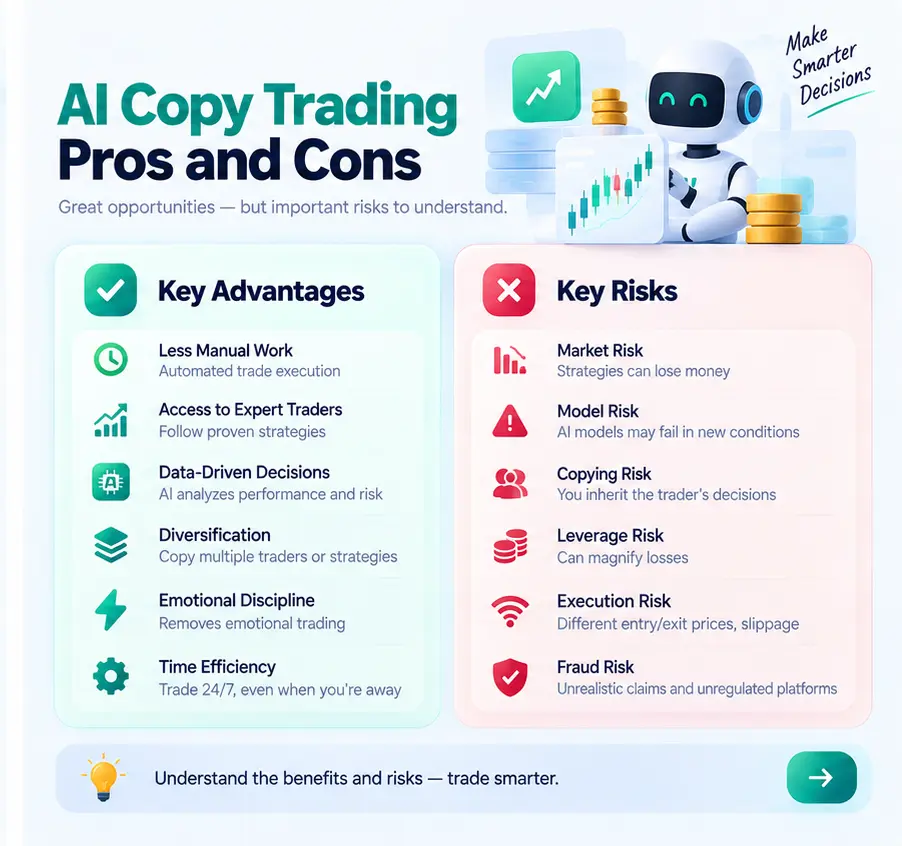
Benefits of AI Copy Trading
AI copy trading can offer several practical advantages.
Lower Manual Work
The system can monitor markets and execute or replicate trades automatically.
Faster Processing
Software can process large amounts of structured data much faster than a human can manually review it.
Greater Consistency
Automation can apply predefined rules without fatigue or emotional hesitation.
Strategy Diversification
Some platforms allow users to follow multiple traders or strategies rather than relying on one source.
Data-Based Monitoring
AI tools may help analyze performance, volatility, correlations, and changes in trading behavior.
These are potential benefits, not guarantees of better returns.
Risks and Limitations of AI Copy Trading
Market Risk
Financial markets can move against a strategy.
AI cannot eliminate losses caused by adverse market movements.
Model Risk
An AI model may be trained on data that does not adequately represent future market conditions.
Conditions not captured during model training, including unusual volatility, major geopolitical events, pandemics, and other shocks, can cause autonomous AI applications to produce unreliable outputs or undesirable trading behavior.
Overfitting
A model can appear excellent on historical data because it was effectively optimized to that particular dataset rather than because it discovered a robust market relationship.
Copying Risk
When you copy another trader, you inherit exposure to that trader’s decisions.
Their risk tolerance may be very different from yours.
Leverage Risk
Leverage magnifies both gains and losses.
A strategy that appears manageable without leverage can become extremely risky when leverage is increased.
Execution Risk
The trade received by the copied account may not be executed at exactly the same price as the provider’s trade.
Differences in spreads, liquidity, market conditions, and execution speed can affect results.
Technology Risk
Automated systems depend on:
- internet connectivity
- broker infrastructure
- software
- APIs
- servers
- data feeds
- third-party providers
A technical failure can therefore become a financial problem.
How to Evaluate an AI Copy Trading Platform
There is no universally “best” copy trading platform for every investor.
The appropriate choice depends on the assets traded, country and regulatory environment, fees, execution, available strategies, risk controls, and the transparency of the platform.
1. Regulation and Legal Status
Determine who operates the platform, where it is based, which regulator oversees the relevant entity, and what protections may apply in your jurisdiction.
2. Performance Transparency
Look for enough information to distinguish actual live performance from:
- backtests
- simulations
- hypothetical results
- demo accounts
3. Drawdown
Drawdown measures the decline from a previous peak in account value.
A strategy with a high return but extreme drawdowns may be unsuitable for an investor with a low risk tolerance.
4. Trading History
Look at the length and consistency of the record rather than focusing only on the latest month.
5. Fees
Consider:
- subscription fees
- commissions
- spreads
- performance fees
- withdrawal fees
- platform fees
6. Risk Controls
Useful controls can include:
- maximum allocation
- stop-loss
- maximum drawdown limits
- position-size limits
- leverage controls
- ability to stop copying
7. Broker and Execution Quality
A sophisticated strategy is still dependent on the execution environment in which trades occur.
How to Evaluate an AI Trading Bot
Before paying for or connecting a trading bot to a live account, ask:
- What exactly does the bot do?
- What market and timeframe was it designed for?
- Is its performance independently verified?
- Does the record come from live trading or simulation?
- What is its maximum historical drawdown?
- What happens during major market events?
- How dependent is it on leverage?
- What fees and transaction costs are included in the reported results?
- Can the developer explain the strategy sufficiently for you to understand its risks?
A bot with an attractive equity curve but no credible explanation of its methodology deserves more scrutiny, not less.
Warning Signs of an Unrealistic or Fraudulent Trading Bot
One of the biggest problems in the AI trading industry is marketing that uses the word “AI” to imply certainty.
Investor.gov, along with the SEC, FINRA, and NASAA, has warned about unregistered platforms promoting AI trading systems with unrealistic claims, including claims that an AI system “can’t lose” or can guarantee exceptional returns.
Be especially cautious when a provider promises:
- guaranteed profits
- zero-risk trading
- a system that “never loses”
- fixed high returns regardless of market conditions
- secret technology that cannot be explained
- immediate wealth
- pressure to deposit immediately
- unverifiable performance screenshots
The absence of information is itself useful information.
A legitimate trading technology should not need impossible promises to explain its value.
Backtesting vs. Forward Testing
What Is Backtesting?
Backtesting means testing a trading strategy against historical data to estimate how it would have performed in the past.
Backtesting is useful for identifying:
- strategy behavior
- historical drawdowns
- trade frequency
- sensitivity to parameters
- performance across different market conditions
But a backtest is not proof of future profitability.
What Is Forward Testing?
Forward testing evaluates a strategy on new data that was not used to develop or optimize it.
This can take place through:
- paper trading
- demo accounts
- simulated environments
- limited live deployment
Forward testing helps answer a different question:
Does the strategy continue to behave reasonably when it encounters information it has not already been optimized against?
Using both approaches is generally more informative than relying on a backtest alone.
Why Strategy Optimization Can Be Dangerous
Optimization is useful because it can identify parameter combinations that historically produced better results.
But excessive optimization can produce overfitting.
Imagine testing thousands of parameter combinations until one produces an exceptionally smooth historical equity curve.
That result may be impressive, but the strategy may simply have been tailored to historical noise.
A robust system should be evaluated using data and conditions beyond the exact dataset used during development.
Risk Management for AI Copy Trading
Position Sizing
Position sizing determines how much capital is exposed to a trade.
A system that risks too much per position can suffer severe damage from a small number of losses.
Stop-Loss
A stop-loss is an order designed to close a position when the market reaches a specified level.
It does not guarantee an exact exit price, particularly during fast markets or gaps.
Drawdown
Drawdown measures how far an account falls from a previous peak.
Tracking drawdown provides a more realistic view of risk than looking at return alone.
Leverage
Leverage allows traders to control a larger position with less capital.
That increases potential gains, but it also increases potential losses.
Diversification
Copying five highly correlated forex strategies does not necessarily provide meaningful diversification.
The underlying strategies may all lose money under the same market conditions.
Manual Trading vs. Automated Trading
| Feature | Manual Trading | Automated Trading |
|---|---|---|
| Human decisions | Central | Reduced |
| Execution speed | Human-dependent | Generally faster |
| Emotional influence | Potentially high | Lower for programmed decisions |
| Flexibility | Very high | Depends on system |
| Monitoring | Often continuous | Can be continuous |
| Technical requirements | Lower | Higher |
| Failure mode | Human error | Technical or model error |
Automation removes some human weaknesses but introduces a different set of risks.
The question is not whether humans or machines are inherently better.
It is whether the specific process is appropriate for the strategy and risk profile.
Can AI Trading Bots Actually Make Money?
Yes, an AI trading bot can make money in some circumstances, but the existence of AI does not guarantee profitability or consistency.
A profitable trading system needs more than a sophisticated model.
It also needs:
- a potentially valid trading edge
- appropriate data
- robust testing
- realistic transaction costs
- adequate execution
- sensible position sizing
- controls for changing market conditions
AI models are especially vulnerable to changes between the environment in which they were trained and the environment in which they operate.
So the more useful question is not:
Does AI make money?
It is:
Does this particular strategy demonstrate evidence of a repeatable edge after accounting for risk, costs, and changing market conditions?
Is AI Copy Trading Profitable?
AI copy trading can be profitable, but it is not inherently profitable.
Copy trading does not manufacture a trading edge. It transfers or replicates one strategy’s decisions.
AI may improve:
- trader selection
- portfolio allocation
- risk monitoring
- signal filtering
- execution
- pattern analysis
But each layer introduces additional assumptions and potential failure points.
Past performance should therefore be treated as evidence to investigate, not as a promise of future results.
Is AI Copy Trading Safe?
No trading system is risk-free, and AI copy trading should not be treated as a safe or guaranteed way to make money.
Safety depends on factors including:
- platform legitimacy
- broker quality
- regulation
- strategy risk
- leverage
- capital allocation
- security
- execution
- transparency
Can AI Predict Financial Markets?
AI can identify patterns, generate predictions, classify market conditions, and process large quantities of information.
That is different from reliably predicting the future.
Financial markets are affected by changing relationships, unexpected events, liquidity conditions, investor behavior, policy decisions, and information that may not have been present in the training data.
AI should therefore be viewed as a tool for probabilistic decision-making, not a crystal ball.
Is MetaTrader Good for Automated Trading?
MetaTrader is widely designed around automated trading capabilities.
MT4 provides MQL4, Expert Advisors, strategy testing, and automated trading functions.
MT5 adds a broader multi-asset architecture and more advanced testing capabilities, including multi-threaded and multi-currency strategy testing.
MetaTrader also provides tools for trading robots, Signals, copy trading, and algorithmic strategy development.
Whether it is the right platform depends on the broker, asset class, strategy, and automation requirements.
How Much Money Do You Need to Start Automated Trading?
There is no universal minimum amount.
The practical requirement depends on:
- the broker
- account type
- asset class
- minimum position size
- margin requirements
- leverage
- bot fees
- strategy risk
A small account can be automated, but that does not necessarily make it economically efficient.
Spreads, commissions, subscriptions, and slippage can represent a large percentage of returns on a very small account.
Can Beginners Use Automated Trading?
Yes, but beginners should avoid treating automation as a shortcut around learning.
A sensible learning path is:
- Understand the market being traded.
- Learn how the strategy works.
- Identify the major risks.
- Test the strategy historically.
- Forward-test it on a demo account.
- Understand fees and execution.
- Start with controlled exposure.
- Monitor the system continuously.
Automation reduces manual execution, not responsibility.
A Practical Framework for Evaluating AI Copy Trading
1. What Exactly Is Being Automated?
Is the system copying people, executing rules, generating AI signals, or combining several technologies?
2. Where Does the Performance Data Come From?
Is it:
- backtested?
- simulated?
- demo?
- live?
- independently verified?
3. What Happens When the Strategy Loses?
Look for maximum drawdown, risk controls, position sizing, and leverage information.
4. Who Controls the Money?
Understand whether funds stay in a regulated brokerage account, whether withdrawals are controlled by the user, and who actually has access to the account.
5. What Happens When the System Fails?
A serious evaluation should consider technical outages, market gaps, model failures, connectivity issues, and unexpected market regimes.
The Future of AI and Automated Trading
AI is likely to become increasingly integrated into trading workflows rather than existing as a separate category.
Future systems may combine:
- machine learning
- natural language processing
- automated execution
- portfolio optimization
- risk monitoring
- alternative data
- large language models
- broker APIs
- cloud infrastructure
This could make trading systems more adaptable and capable of processing more information.
But greater sophistication also increases model, operational, cybersecurity, and systemic risks.
The result is likely to be a trading environment where technology becomes increasingly powerful—but where transparency, testing, risk controls, and human oversight remain essential.
Frequently Asked Questions
What is AI copy trading?
AI copy trading combines automated copy trading with artificial intelligence or machine-learning tools. The AI component may help select traders, analyze strategies, filter signals, allocate capital, monitor risk, or generate trades. The exact meaning varies by platform, so users should determine what the platform actually means by “AI.”
Is copy trading profitable?
Copy trading can produce gains or losses. Profitability depends on the strategy being copied, market conditions, execution, fees, leverage, and risk management. Historical performance does not guarantee future results.
Is AI copy trading safe?
AI copy trading is not risk-free. Users face market, model, execution, technology, leverage, and fraud risks. Investors should verify the platform, understand the strategy, and assess risk before committing capital.
Is copy trading legal?
The legal and regulatory treatment of copy trading depends on the jurisdiction, platform, instruments, and how the service operates. In some jurisdictions, copy trading may fall under portfolio or investment management rules.
What is an AI trading bot?
An AI trading bot is software that uses AI, machine learning, quantitative models, or related technologies to analyze financial data and potentially generate or execute trades.
Can AI predict financial markets?
AI can analyze financial data and generate predictions or probabilities, but it cannot reliably predict markets with certainty. Unexpected events, changing market conditions, data limitations, and model errors can produce incorrect predictions.
Can an AI trading bot guarantee profits?
No legitimate technology can guarantee trading profits. Claims that a bot cannot lose or guarantees extraordinary returns are major warning signs.
What is automated trading?
Automated trading uses software to execute trading rules or decisions without requiring the trader to manually place every order. It may use simple rules, quantitative models, trading bots, Expert Advisors, or AI systems.
What is an Expert Advisor?
An Expert Advisor, or EA, is an automated trading program used within MetaTrader. EAs can analyze market data and execute trading instructions according to their programmed logic.
Is MT4 or MT5 better for automated trading?
Neither is universally better. MT5 offers broader market support and more advanced testing capabilities, while MT4 has a long-established MQL4 ecosystem. The appropriate choice also depends on broker support and the specific EA or strategy being used.
Can I use trading bots with MetaTrader?
Yes. MetaTrader supports automated trading through Expert Advisors. MT5 includes tools for creating, testing, optimizing, and running trading robots.
Is automated trading suitable for beginners?
Beginners can use automated trading, but they should understand the strategy, test it carefully, use sensible risk controls, and avoid treating automation as a substitute for learning.
How much money do I need to start automated trading?
There is no universal minimum. Requirements depend on the broker, instrument, minimum trade size, leverage, fees, and strategy. A smaller account can also be disproportionately affected by transaction costs and subscriptions.
What is the safest way to test a trading bot?
A prudent testing process combines historical backtesting with forward testing, preferably using a demo or controlled environment before significant live capital is committed.
What are the biggest risks of automated trading?
Major risks include model failure, overfitting, excessive leverage, poor execution, technical outages, changing market conditions, data problems, and inadequate risk management.
How do I choose an AI trading bot?
Evaluate its methodology, verified live performance, historical drawdown, fees, leverage, execution requirements, testing methodology, transparency, developer credibility, and regulatory context. Avoid systems that rely primarily on guarantees or unrealistic return claims.
Conclusion
AI copy trading sits at the intersection of several technologies: copy trading, algorithmic execution, artificial intelligence, machine learning, portfolio allocation, and automated risk management.
The basic idea is straightforward. Instead of manually deciding every trade, an investor can use software to replicate another trader’s activity or follow algorithmically generated signals. AI may add another layer by analyzing traders, market conditions, data, or risk.
But AI does not eliminate uncertainty.
The strongest approach to evaluating these systems is to look beyond the label. Ask what is actually automated, what data the model uses, how performance was measured, how much risk is being taken, and how the system behaves outside its best historical scenarios.
Ultimately, a credible AI copy-trading system should be judged by transparency, testing quality, risk management, execution, and independently verifiable evidence—not by the word “AI.”